The FHWA’s Center for Local Aid Support has developed a series of self-paced online training courses for local agencies and tribal communities. The addition of these courses demonstrates the agency’s commitment to empowering transportation professionals with the skills necessary to deploy new innovation that keeps transportation moving into the future.
The courses are conducted 100% online and are on-demand, allowing users to learn at their own pace and on their own time.
The training courses focus on Every Day Counts initiatives such as:
Safe Transportation for Every Pedestrian (STEP)
Geosynthetic Reinforced Soil – Integrated Bridge System (GRS-IBS)
Gravel Roads Construction and Maintenance
Construction Inspection of Rockeries
Project Bundling: (1) Fundamentals Event, (2) Staging the Bundle Event, and (3) Creating and Contracting the Bundle Event
CLAS will continue to develop training that will keep transportation moving into the future. These courses can be accessed on the CLAS website. Additionally, access to previous and upcoming webinars by CLAS can be found here.
The Delaware Valley Regional Planning Commission (DVRPC) is advancing the development of bike-friendly infrastructure in coordination with road resurfacing projects in the Pennsylvania portion of the agency’s region. DVRPC is a metropolitan planning organization that includes nine counties in two states: Bucks, Chester, Delaware, Montgomery, and Philadelphia in Pennsylvania; and Burlington, Camden, Gloucester, and Mercer in New Jersey. Sarah Moran, Manager, DVRPC Mobility Analysis and Design, and Jesse Buerk, Manager, DVRPC Capital Project Development discussed the Bike-Friendly Resurfacing program in four Pennsylvania counties.
What is the program?
The DVRPC Bike-Friendly Resurfacing Program identifies roads for potential investment in bike-friendly improvements as part of regularly scheduled Pennsylvania DOT (PennDOT) resurfacing projects. DVRPC, PennDOT, the four suburban counties, and the Bicycle Coalition of Greater Philadelphia are working together to provide resources to local municipalities to improve the biking environment. PennDOT began the PennDOT Connects program to involve municipalities early in the planning process for state-sponsored transportation projects. The Bicycle Coalition of Greater Philadelphia is an advocacy group that works on the local level to inform municipalities about the program and connect residents with the counties and DVRPC. The Coalition also contributes information on local bicycling routes and route conditions.
PennDOT’s five-year resurfacing program for four suburban counties (Montgomery, Delaware, Chester, and Bucks) establishes the planned repaving schedule for state-owned roads. The Bicycle Coalition of Greater Philadelphia created an interactive Google map of the paving projects for each year in the 5-Year Resurfacing Plan Map organized by county.
How does the program work?
To encourage more municipal interest in bicycle facilities, PennDOT District 6 worked with DVRPC, planners from the four southeastern Philadelphia suburban counties, and the Bicycle Coalition of Greater Philadelphia to get regional support. PennDOT, DVRPC, the counties, and the Bicycle Coalition evaluate which segments on the resurfacing schedule are good candidates for bike-friendly improvements. DVRPC then reaches out to the municipalities to tell them about the opportunities and see if they are interested. Although PennDOT pays for the design and installation of the improvements, the municipalities need to comply with the bike improvement maintenance requirements set by PennDOT. The Bicycle Coalition of Greater Philadelphia helps make the case for new bike facilities to municipal decision makers on an as-needed basis.
How are road segments prioritized?
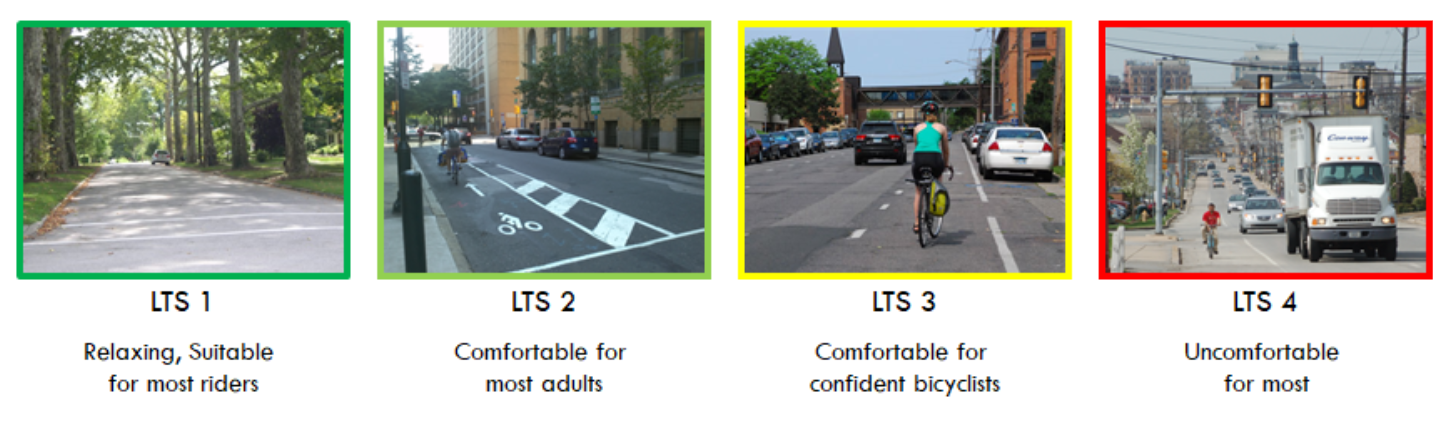
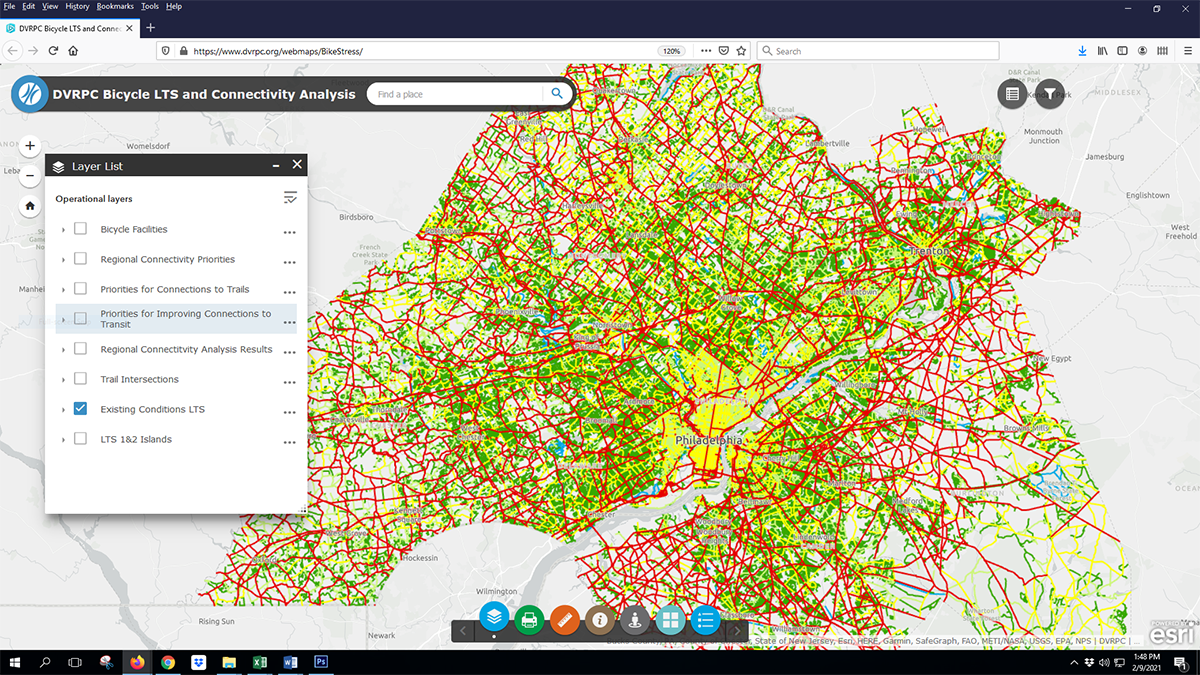
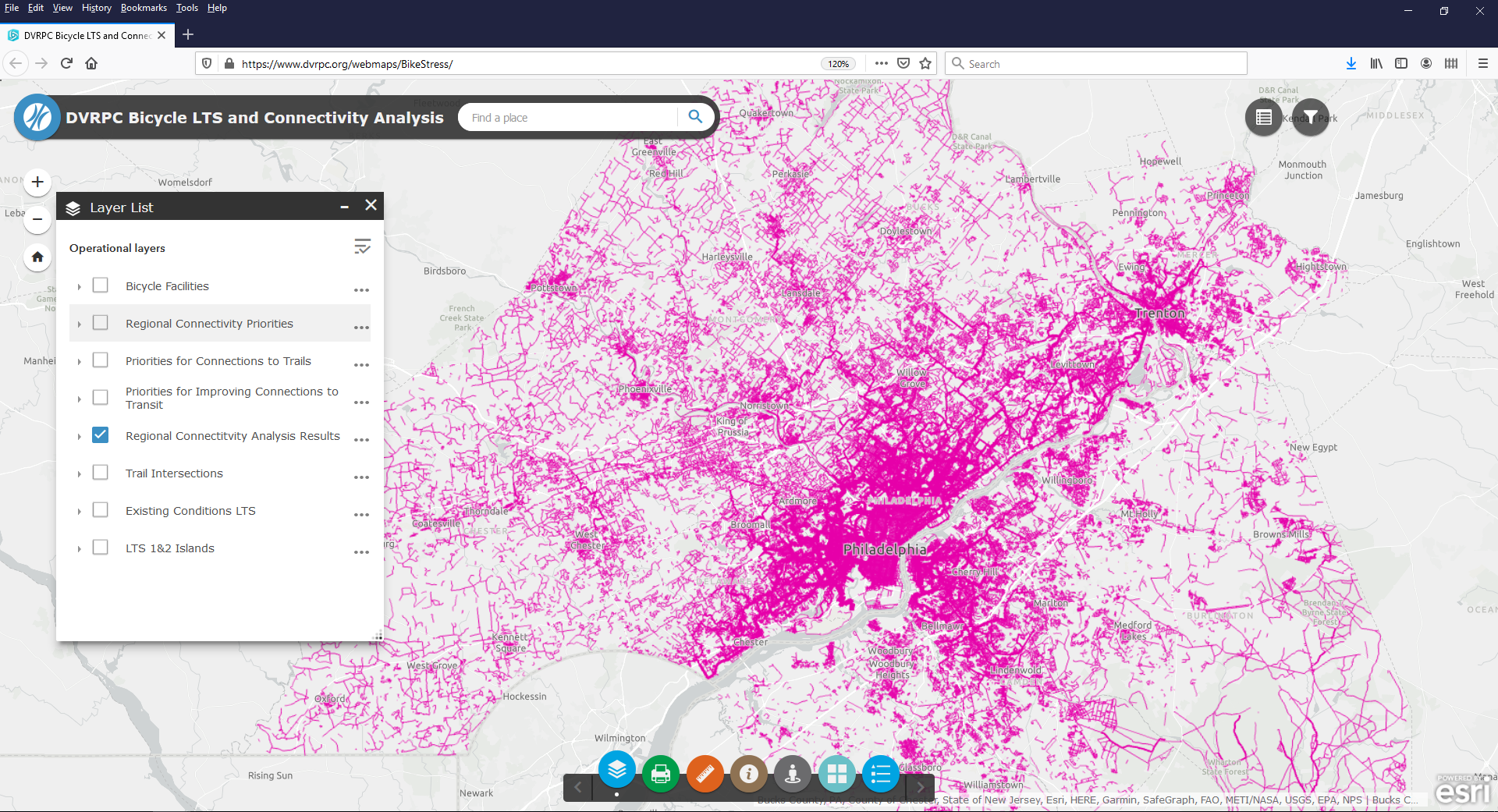
DVRPC developed an online interactive Bicycle LTS and Connectivity Analysis map. It measures both levels of traffic stress (LTS) and connectivity of road segments. LTS is a bicycle comfort index for streets and paths that was initially developed by Peter Furth at Northeastern University expressed in the Mineta Institute publication, Low-Stress Bicycling and Network Connectivity. LTS as a classification scheme ranges from 1-4. LTS 1 identifies roads that are relaxing and suitable for most riders; LTS 2 roads are comfortable for most adults; LTS 3 roads are comfortable for confident bicyclists; and LTS 4 roads are not suitable for bicycle riding. (see Figure 1) The Bike-Friendly Resurfacing Program prioritizes LTS 3 roads for improvement because they present the greatest opportunity to make them comfortable for more riders. (Figure 2 shows the web map made by DVRPC for multi-layer analysis.) The existing LTS layer classifies the road condition for the Delaware Valley Region, including the Greater Philadelphia area and four counties in New Jersey.
The connectivity analysis looked for the shortest path between any two census blocks within five miles. Improvements along the roads identified as priorities within this area would be most beneficial to build out a bicycle network by enabling the most low-stress bicycle connections(Figure 3). The bigger the role a road plays in connecting to multiple census tracts, the greater the chance it will be selected for bicycle improvements.
DVRPC is working to improve the Bicycle LTS and Connectivity Analysis by adding an equity analysis component. DVRPC considers which communities the route passes through and who lives there, based on analysis of nine indicators of potential disadvantage, such as minority populations, low-income populations, and persons with disability. Every geography is given an overall score. Areas with an above average score have a higher proportion of these traditionally disadvantaged populations and this value is assigned to routes.
DVRPC is working to build this information into the connectivity analysis in order to prioritize places with more need. DVRPC updates the Bicycle LTS and Connectivity Analysis map on a regular basis to address errors in the network, new trails, and changes in the equity analysis. Another pending improvement is consideration of slope.
The county transportation planners review every segment scheduled to be repaved in a given year for potential connections. Every segment that is identified as a priority by any of the partners goes to the next step for more analysis related to characteristics such as road width, speed, traffic volumes. Every county has a sense of priorities, including knowledge of county and municipal plans, so this process is not limited to just a technical analysis.
Figure 1. Levels of Traffic Stress, a bicycle rider comfort index, rates roads and paths from 1 to 4
Figure 2. DVRPC map shows existing conditions map for Levels of Traffic Stress
Figure 3. Regional map showing concentrations of connectivity between census blocks
When were the first projects implemented?
The first municipal projects were implemented in 2018 after an initial trial run of this program. In 2019, DVRPC started looking at all projects in relation to the five-year resurfacing plan. Currently, the process includes working one year ahead to build up a pipeline of projects for each coming year. There are many variables that affect how many projects can be completed, such as budget, weather, and shifting priorities. Municipal engagement takes time to establish and depends on local resources.
How is the program funded?
Congestion Mitigation and Air Quality (CMAQ) funds identified in the regional Transportation Improvement Plan (TIP) cover the design costs for these bicycle improvements on state highways scheduled for resurfacing. All the counties had to agree to this, even though the county of Philadelphia is not using these funds. The City of Philadelphia has a parallel program, as the City has the ability to design its own striping plans. PennDOT pays for the actual implementation of the improvements, and municipalities are responsible for the cost of maintenance.
The exact number of projects that are able to be implemented varies from year to year. DVRPC generally aims to complete two to three projects per county per year. It can be difficult to complete projects in rural areas, due to the program’s restrictions, such as being limited to the existing cartway width. However, DVRPC tries to look ahead for opportunities to even out the distribution of funding between the counties. As of now, six bike resurfacing projects have been completed and nine projects are in the pipeline.
What challenges has the program faced?
There are some challenges in getting municipalities to make the formal request to PennDOT. They have varying resources, and procedures for approval tend to be different for each community. In some cases, success comes down to finding the right contact to promote the project benefits to the community. Municipalities may lack equipment for stenciling and painting the road between resurfacings, and ongoing maintenance can be a challenge for them to take on.
All projects are limited to what can be implemented with paint. There are road segments that are too narrow to add bike facilities but at this time, it is not possible to widen or re-crown roads through this program. DVRPC keeps a list of projects that would require larger capital investments. The hope is to find ways to address these more complicated projects with other funding sources.
Why does the program work and will it work elsewhere?
Coordination and communication are key to the success of the program. Other regions could follow the process with or without the LTS analysis. Even without the technical analysis, it would be possible to establish a simple database for tracking. DVRPC developed FAQs and other communications for municipalities, which also have general applicability. The connectivity analysis guides decision-making, but innovative technical tools only go so far. Relationship building and cooperation are needed to identify good projects and to see them through to implementation.
Matthew Zochowski, a Transportation Planner with Mercer County spoke with us about Mercer County’s Bicycle-Friendly Repaving program to make roads safer for bicyclists by creating a network of bike routes throughout the County. He drafted the County’s 2020 Bicycle Master Plan, a sub-element of the Mobility Element of the County Master Plan.
What inspired the bicycle-friendly resurfacing program? What were the considerations when you started this approach?
Going back to where things really started would be with Matt Lawson, the Principal Planner-Transportation for Mercer County, who came to the county in 2005-6, and encouraged the engineering and planning divisions, our regional partners and municipalities, to improve the road network for bicycle use. He helped inspire our bicycle planning efforts and helped move them forward. Along with him, several people working at the County were outdoor enthusiasts who enjoyed hiking and bicycling and wanted other County residents to be able to use the roads and trails in a safe manner. Our County Administration as well as our new County Engineer, George Fallat also placed a larger emphasis on road safety which included bicycles and pedestrians.
In 2009, the Mercer County Bike-Pedestrian Task Force (MCBPTF) was created with the support of Mercer County Executive, Brian M. Hughes, and hosted by the Greater Mercer Transportation Management Association (GMTMA). The MCBPTF consists of municipal representatives designated by town mayors as well as various advocates and residents. The primary purpose of the organization is to help advocate for non-motorized infrastructure throughout Mercer County, including sidewalk improvements, bicycle improvements, intersection improvements, trail improvements, and many others. The group also acts as a forum to coordinate municipal efforts and keep each other informed of activities happening around the County.
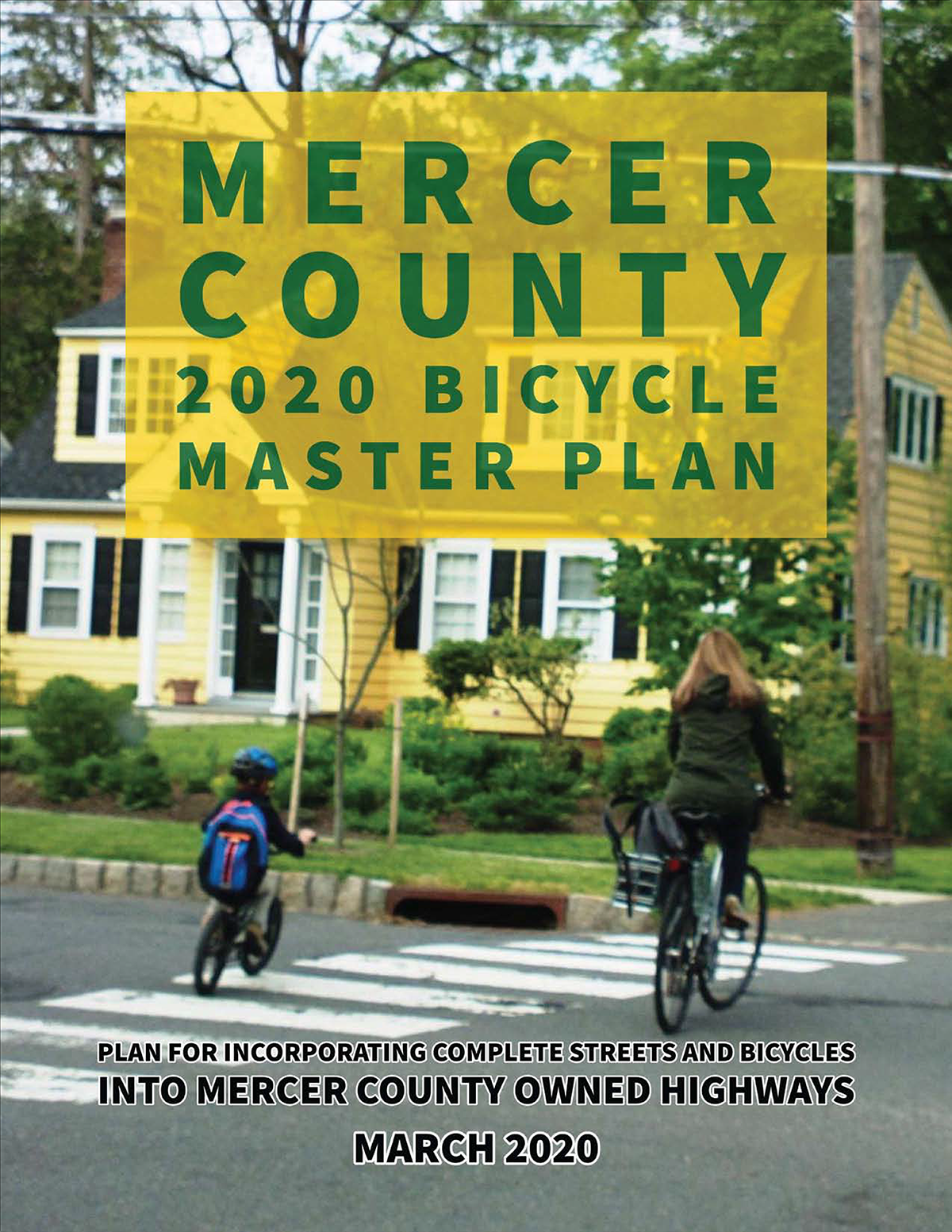
The Mercer County Bicycle Master Plan promotes bike-friendly resurfacing in alignment with the County’s Complete Streets policy
When I came to the County in 2017, I took on the projects Matt had been working on and the bike plan was one of the first things I was tasked with advancing. The County had already passed a Complete Streets policy in 2012 to promote safe access and mobility for all users of all transportation modes and since that time, every municipality in Mercer County has adopted their own Complete Streets policy. With a consistent policy across all jurisdictional levels, we knew that Mercer County had a common goal of advancing these types of projects.
Work began on the Bicycle Master Plan in 2017 with the goal of creating a continuous network of bicycle facilities on County-owned roads. At first, we were looking at establishing just a couple of routes, but we realized that the process that we were using could be applied to any number of routes. We took a comprehensive look at the entire 180 centerline miles of the county road network in 50- to 400-foot intervals, and particularly more highly traveled routes which were perfect candidates to incorporate bike lanes to create meaningful connections.
During our planning efforts, we had found out that one of the routes we were looking at was actually going to be repaved and our County Engineer allowed us to advance a concept we developed in-house. As a result of that project and experience, we have shifted to our resurfacing program as the main implementation method for building out our bicycle lane network. This bicycle friendly resurfacing program helps us implement the Complete Streets policy and Bicycle Plan.
We used the Federal Highway Administration’s (FHWA) guidance document Incorporating On-Road Bicycle Networks into Resurfacing Projects to support the effort, and in particular, the argument for cost savings. This piecemeal method of incorporating bike lanes significantly reduces cost of each project and we believe that you have to start somewhere so that years down the line you have a connected network of routes. This was the same problem back in the day when planning boards began requiring sidewalks for developments that were in the middle of nowhere but over years as neighboring properties developed, they created a connected sidewalk network.
What factors did you consider when you identified roads for bicycle improvements?
Factors for analysis of our County Routes is described in great detail in the Mercer County Bicycle Master Plan. We looked at cartway width, environmental constraints, crashes records involving bicycles, network connectivity, Level of Traffic Stress (LTS), Annual Average Daily Traffic, truck volumes, existing bus routes, existing and proposed speed limits, bicycle travel demand modeling and 8-80 Design. The idea behind 8-80 design is that if you design a project for an 8- year-old and an 80-year-old, it should work for nearly every person.
To anticipate the cost for implementation, we created a linear foot calculator in MS-Excel that looks at the type of facility and is assigned a code based on the amount of work needed to create an improvement. That code is based on both our striping contract in 2019 as well as general construction costs we tried to localize to New Jersey. When the code is multiplied against a linear foot number, we get a fairly accurate general cost estimate.
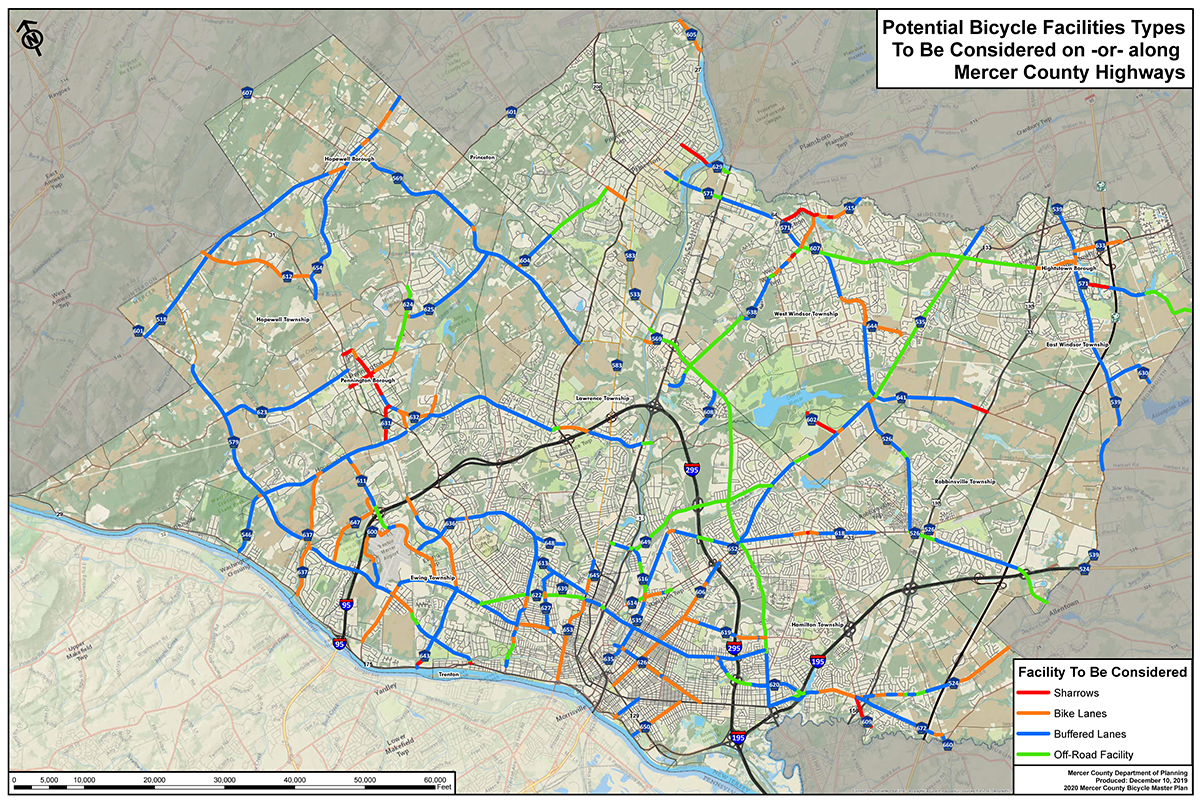
Mercer County uses their map of potential bicycle facility types for all County roadways and the Highway Department’s repaving schedule to identify projects for each paving season
To create our Excel table and map of the bicycle route analysis, we used a combination of GIS, Google Earth, field visits and Nearmap to define the cartway width, speed limit, pinch points, pedestrian activity, bus routes, and other factors with the goal of recommending a facility for every county road. Now, the plan does not commit the County to a particular projects or final recommendations because priorities and conditions can change. Our plan specifically mentioned that the map shows “Facilities to Be Considered” at the time when we draft concepts for advancement.
What projects have you implemented so far?
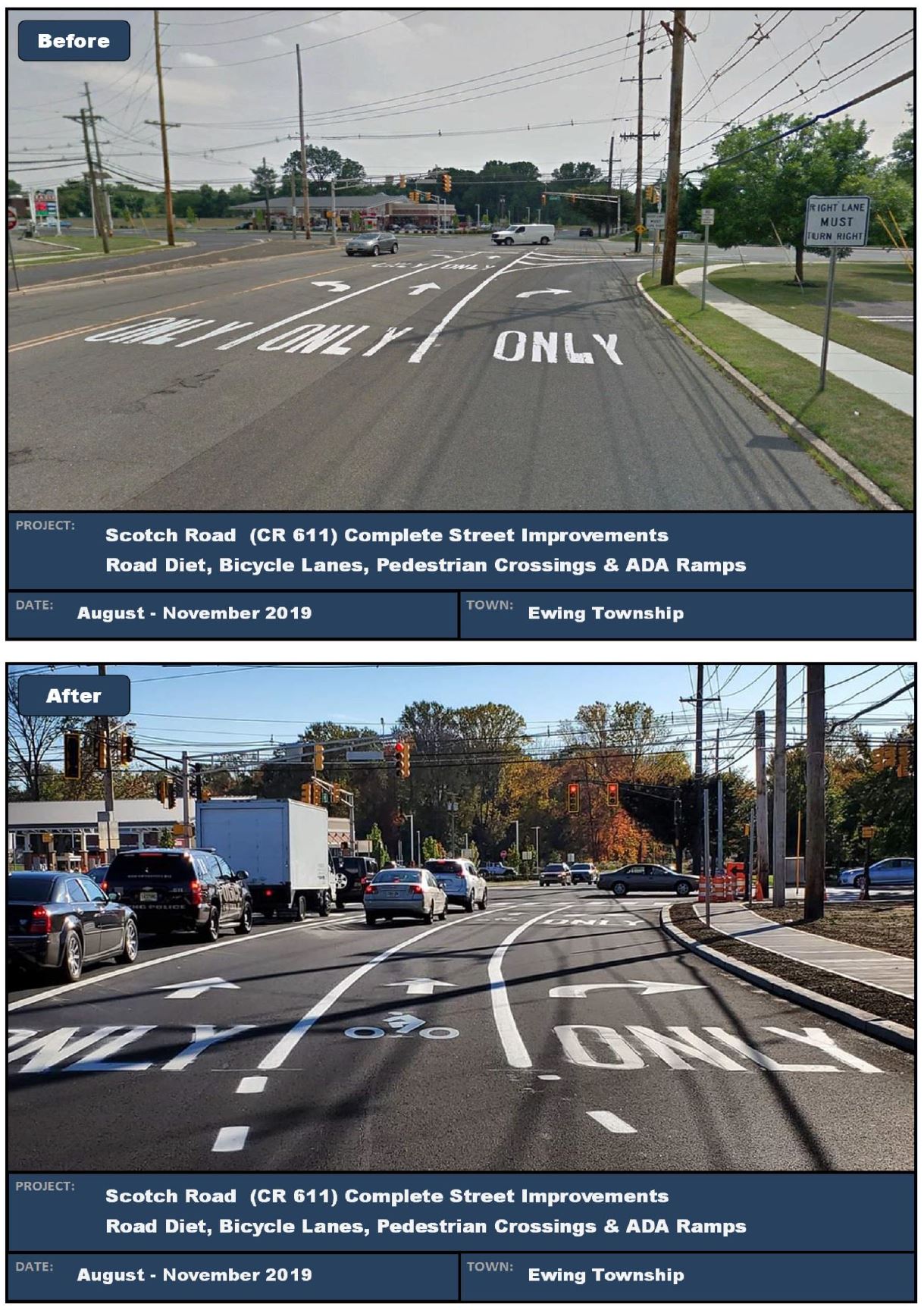
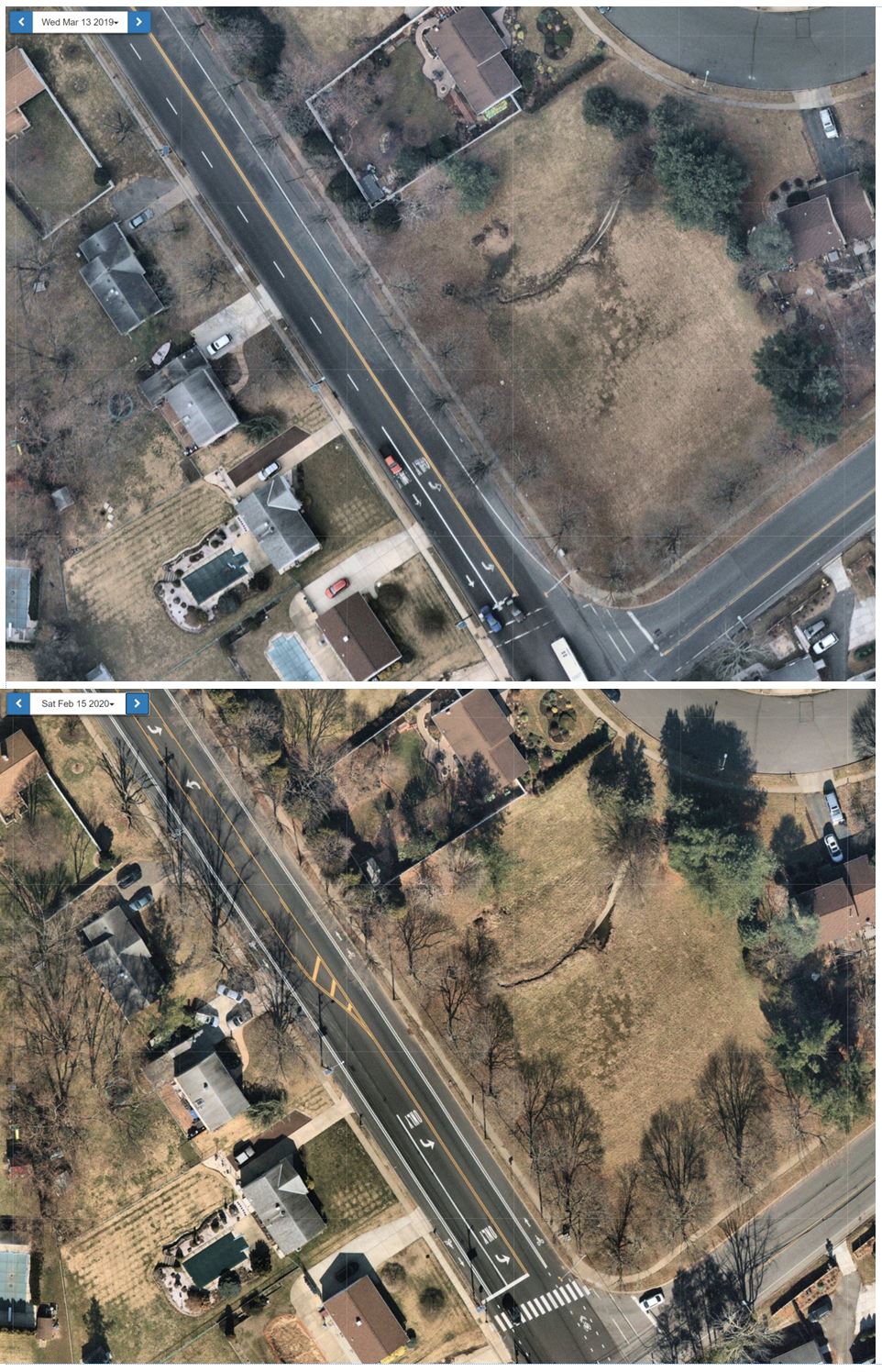
The 2019 Pilot Bicycle Paving Program included the implementation of almost seven miles of new bicycle lanes and we learned a lot that year on internal process and coordination with our towns. Our first real project was Scotch Road in Ewing Township which included a road diet with a 4-lane to 2-lane with center turn lane conversion. That project included buffered bike lanes and will eventually connect to a larger 17-mile “Greater Western Bikeway” project to the north and to the proposed bike lanes and extension of Silvia Street by Ewing Township to the south.
Since that time, we also implemented bicycle lanes on Elm Road in Princeton, N Main Street in Hightstown, Ewingville Road in Ewing, Prospect Street in Ewing and East State Street in Hamilton. We’ve also marked out sharrows in a few other locations. At this point, we essentially work with our Highway Department to receive the year’s repaving program and see where we can work to implement projects. Since we will need to have a crew out there to restripe, we look at those projects to determine what our year’s priorities will be.
Restriping on Scotch Road resulted in addition of a bike lane between the through lane and the right turn lane
In 2019, the Delaware Valley Regional Planning Commission (DVRPC), the Metropolitan Planning Organization for our region, provided traffic engineering and bike facility planning assistance to help determine the feasibility of bicycle improvements on a segment of County Road 636 which is the main corridor between urban Trenton and suburban Ewing and The College of New Jersey. DVRPC assisted with the segment, between Rt.31 and Olden Avenue, which involved looking at two intersection redesigns.
Will the County take on more projects that are more than just restriping?
The plan includes a variety of routes, some of which require simple striping and others that will require more intensive work such as road widening or intersection redesign that may involve drainage or right-of-way issues for example. We prioritize the roadways that are in need of repaving, and only need additions of epoxy paint or thermoplastic and signage to define the bicycle facility. We continue to plan for more complicated segments and work with our on-call engineering contractors as well as with our in-house staff. In the future, we will likely apply for federal funding for more significant and more complicated projects.
Projects are primarily funded through the County’s capital budget. The County has applied for federal grants for projects as well. In 2018, we received a $2.3 million Transportation Alternatives Program (TAP) grant for the Great Western Bikeway, a 17.5 mile route in the northwest part of the county that primarily will follow County Road 546 and run between Delaware and Raritan Canal towpath trails at Rt. 29 and Rt. 1.
Do you work with any municipalities on bicycle infrastructure on municipal roads?
We have assisted a few townships, either with general planning assistance or in design but all municipalities are not ready to take on this approach. We try to reach out to towns about coordinating efforts and we have a close working relationship with several towns. In those situations, we feel that we can build out a complete and connected network relatively easily. Other towns tend to be more closed off to and stick to home rule more than others. Despite that, we can still create a high level of connectivity throughout the County by establishing bicycle infrastructure on County roads which already serve as main connections between our municipalities and adjacent Counties.
Ewingville Road improvements included addition of bicycle lanes in both directions
Are you aware of other counties working on bicycle-friendly resurfacing?
I am not aware of other counties using this approach, or not to the extent that Mercer County is. It seems like Camden and Burlington Counties are not doing as much work with on-road bicycle networks, but are putting a lot of good work into establishing off-road trail networks and multi-use paths. Mercer County is one of eight NJ counties that have a Complete Streets policy, and the policy has really guided the Bicycle Master Plan. The success of the program is in part due to the support of both the Mercer Board of County Commissioners and the local pedestrian and bicycle advocate community.
Do you anticipate that Mercer County will be able to continue this program?
Yes, we will continue to work with the Bicycle Master Plan and coordinate on the paving list from our highway department. We’ll continue to select road segments for each year’s projects, conduct an on-site evaluation for each, and make recommendations to the County Engineer. We plan for 8 or so new repaving projects this year and generally have had 2-5 projects in an average paving season. For our larger projects, we will continue to go after state and federal funding which will help us with larger improvements that go beyond repaving.
We will continue to integrate bicycle facilities into resurfacing projects and make sure bicycle facilities are considered during routine road maintenance, reconstruction, construction, and land development reviews to create a network in alignment with the County’s Complete Streets Policy.
Resources
Delaware Valley Regional Planning Commission and Mercer County. (2020). Local Concept Development, North Olden Avenue, New York Avenue to Pennington Road. Project Information Website. Retrieved from: http://creative-mt.com/oldenavenue/
When cities, counties, and other local public agencies (LPAs) use Federal funds for transportation projects, they must follow all of the applicable Federal laws and regulations attached to the Federal aid. NJDOT, like other state departments of transportation (DOTs), oversees the LPA program and works with agencies to help them use Federal-aid effectively. During Round 2 of the Every Day Counts Program (EDC-2), FHWA promoted innovative strategies for overcoming common challenges with Locally Administered Federal-Aid Projects including practices for enabling “Consultant Services Flexibilities” on local programs and projects.
To aid its LPAs in the delivery of its non-traditional projects programs, the NJDOT Division of Local Aid and Economic Development (Local Aid) established the Local Aid Design Assistance Program. The Design Assistance Program seeks to support LPAs that have received federal grants through the Safe Routes to School and Transportation Alternatives Set-Aside (TA Set-Aside) programs. The Program provides a pool of pre-qualified engineering design consultants to assist LPAs with plans, specifications and estimates (PS&Es) with the goal of seeing more infrastructure projects implemented. Laine Rankin, Director of Local Aid and Economic Development, and Julie Seaman, Project Management Specialist, described the program.
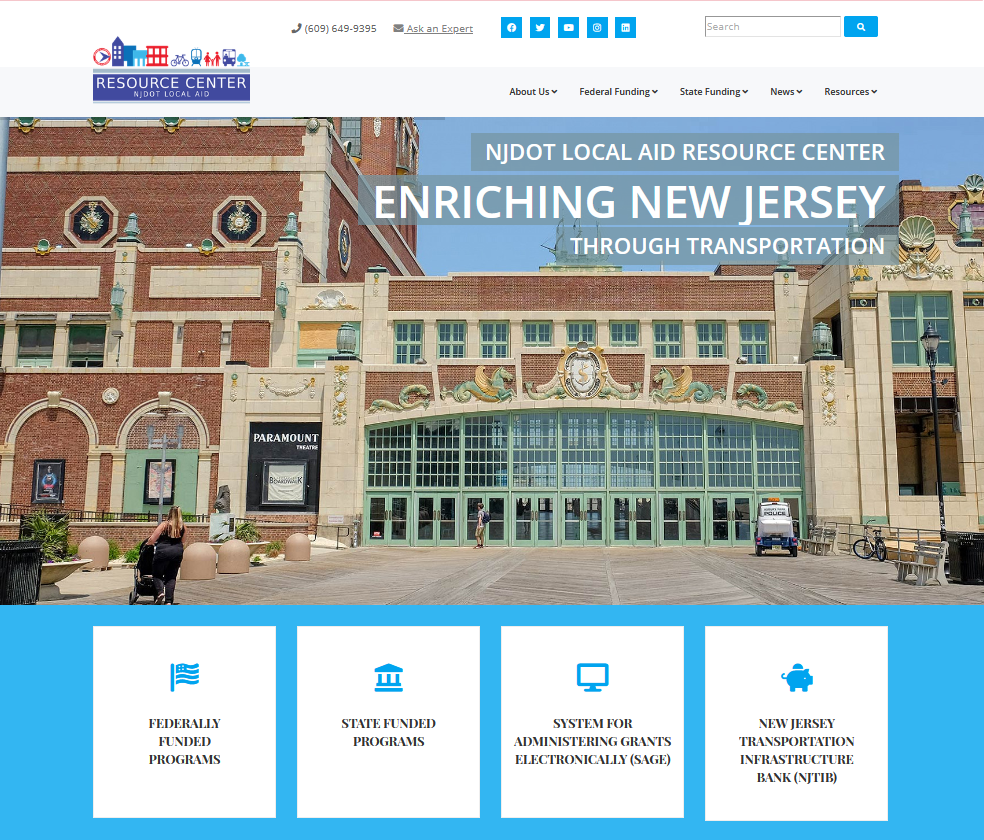
The NJDOT Local Aid Resource Center website provides links to information on the Design Assistance Program
What are some of the most common challenges local agencies face with the project design process?
LPAs often face lack of staff, lack of funding, and staff turnover, all of which can limit their capacity to take on the federal grant process and can result in delays in infrastructure project planning and implementation. Because New Jersey is a home-rule state, the State has limited jurisdiction over county or local roads. Instead, the municipalities and counties are responsible for infrastructure improvements on their roads. The NJDOT Local Aid Office assists the municipalities in implementing these projects by administering the federal funding for them. Local Aid is ultimately responsible for the spending of these federal dollars.
Safe Routes and TA Set-Aside grant recipients face challenges in understanding and complying with requirements related to federal grant administration. In particular, the requirements of the Brooks Act, also known as Qualifications Based Selection, prove difficult to satisfy in project administration. The Brooks Act details federal requirements for the procurement of professional services of consultants, including:
Issuing a request for proposal or RFP from consultants based on approved written procurement policies and procedures
Solicitation, evaluation, ranking and selection of consultants
Selecting a consultant based on qualifications and experience, not cost
Negotiating a fair and reasonable cost and contract terms with selected consultant
Monitoring the consultants’ work
Evaluating the consultants’ performance
Contract completion
How does the design assistance program work?
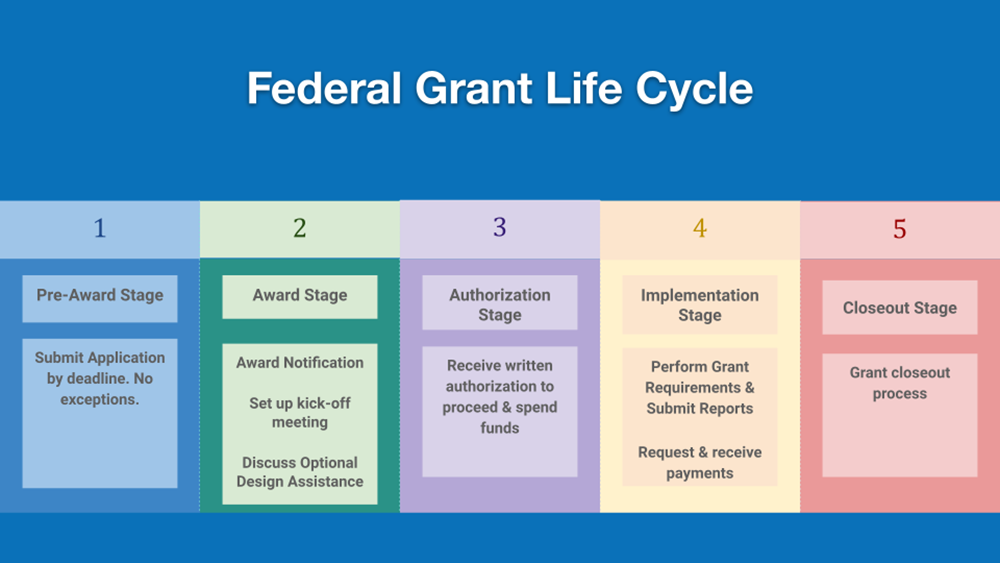
The federal grant process
Most grant applications that Local Aid receives do not describe projects that are construction-ready. LPAs need assistance to complete designs, and develop engineering plans, specifications, and estimates required to see a project built.
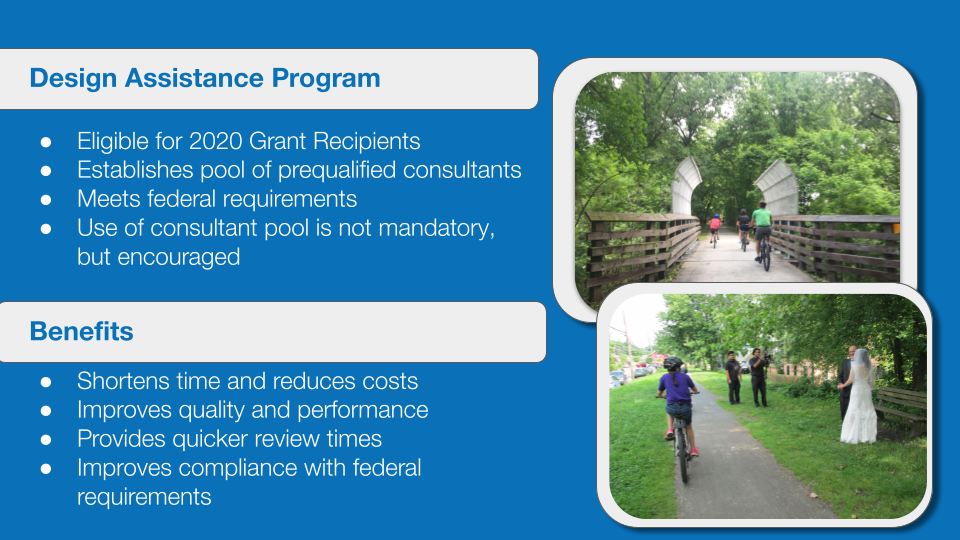
Through the Design Assistance Program, NJDOT procures a pool of design consultants that LPAs can then choose to work with. Once NJDOT and the MPOs have chosen the projects that will be funded for a grant cycle, Local Aid develops a Request for Proposals (RFP) that lists the selected projects and scope for each grant. The NJDOT Office of Procurement solicits a pool of engineering firms that will be able to assist the grant recipients with their particular projects. The firms considered for the pool are typically familiar with requirements associated with developing a set of plans which are compliant to the NJDOT plan and AASHTO standards. Once the consultant pool has been approved by NJDOT management, a letter is sent to all of the grant recipients of that grant cycle informing them of the engineering firms available.
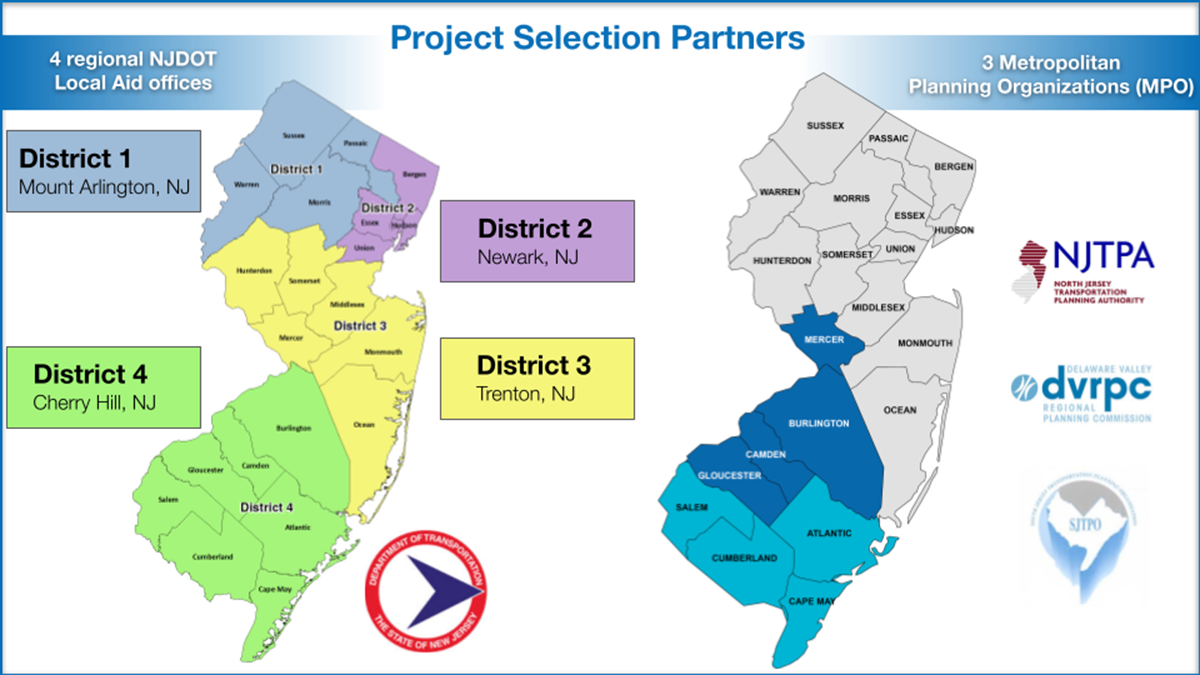
The NJDOT Local Aid Office partners with NJ’s three Metropolitan Planning Organizations in the TA Set-Aside project selection process
Funding for design assistance comes from the same line of federal funding as the SRTS grant and the TA Set-Aside grants. LPAs receive grant funds for the design program above the amount awarded for the project itself.
For how many years has the design assistance program been operating?
Although this is a pilot program, we initiated the process in April of 2014 and it took about a year and a half to get it up and running following meetings with FHWA, NJDOT Procurement, and the NJDOT Deputy Attorney General. Our office talked to peers in other states including Kentucky, New York, Missouri, among others to understand how other Local Aid offices were handling design assistance for grant recipients and the consultant solicitation process. Design assistance programs were developed for both the Safe Routes to School (SRTS) and the Transportation Alternatives Set-Aside (TA Set-Aside) programs. Design assistance first became available to grant recipients in the 2014 grant round and we solicit grant applications on a two-year cycle, or after a grant solicitation for that particular program has been completed.
TA Set-Aside Grant Webinar explained the purpose and benefits of the Local Aid Design Assistance program
The design assistance program is introduced in our general training session for applicants that describes how to apply for a Safe Routes or TA Set-Aside grant. After the grant awards are announced, information about the program is included in the letter that we send to grant recipients, and a separate informational session is held with grant recipients to discuss the design assistance pool. All grant recipients are eligible to take part in the program; they do not apply for the program and there is no obligation to take part.
Can you say what percentage of grant recipients choose to use the program?
It has taken some time to publicize the program, but awareness among LPAs is growing. In 2016, 19 of 36 TA Set Aside grant recipients, and 12 of 17 SRTS grant recipients elected to use the program. Our 2018 pools are still open; to date, 13 of 25 TA Set Aside grant recipients and 13 of 18 SRTS grant recipients have shown interest in the program. We have approval from FHWA to keep the pool open for a year, with an option to extend up to two years. If an LPA proposes a TA Set-Aside project that involves some specialized work that the engineering firms could not respond to – such as architectural design, then the LPA will not be able to use the design assistance program.
Do NJDOT, the LPA, and the consultants work together through the design assistance process?
Yes. The project application is reviewed and a field meeting is typically scheduled with representatives of the LPA, the consultant engineering firm, the Local Aid regional office, and NJDOT environmental staff. The LPA, NJDOT, and the consultant then work together to develop the scope of work. The consultant prepares a fee proposal and Local Aid develops an independent cost estimate that is used to compare with the consultant’s proposal. NJDOT assists in negotiating the agreement between the LPA and the consultant but the LPA executes an agreement directly with the consultant. NJDOT authorizes federal-aid funds for the design, in excess of the project grant award. The LPA continues to work with the Local Aid District Office through the design process, and NJDOT conducts an environmental review as well. Before the project goes to construction, the plans and specs are submitted to the Local Aid District office for approval in order to ensure a biddable, buildable, project. The LPA pays the consultant directly and then requests reimbursement for the cost from NJDOT.
slide-1
slide-2
slide-3
slide-4
slide-5
What benefits have you seen from the program?
In our experience, what may seem like a simple project, such as installing a sidewalk, can be very complicated. In many cases, particularly for Safe Routes projects, the design costs may exceed the construction costs. We provide design funds for LPAs that choose to procure an engineering firm, but the LPA must comply with the Brooks Act in their procurement process. Some LPAs choose to work with their municipal engineer, but the engineer must be qualified to do the work. Municipal engineers who are involved in the design of these projects are not allowed to also inspect the projects, and these inspection costs increase the overall project cost for the LPAs. For LPAs not using in-house engineering services, the design services procurement process is burdensome.
Through the Local Aid Design Assistance Program, we are distributing more federal funds and seeing more projects advancing than in the past. When we give a grant out, we want folks to build it. LPAs can develop more involved projects. The program results in better compliance with complex state and federal regulations and helps resolve typical engineering issues, such as right-of-way and utilities, that can affect project cost and schedule. LPAs are better prepared for the permitting process.
Do you see the program continuing into the future?
We will be continuing the program. There are always some tweaks to be made but the program is helping local agencies implement projects that improve health and safety throughout the State.
Resources
American Council of Engineering Companies (ACEC). (u.d.). The Brooks Act: Federal Government Selection of Architects and Engineers. Public Law 92-582, 92nd Congress, H.R. 12807, October 27, 1972. Legislation on Website. Retrieved from: https://www.acec.org/advocacy/qbs/brooks/
American Council of Engineering Companies (ACEC). (u.d.). The Brooks Act: How to use Qualifications Based Selection. Website. Retrieved from: https://www.acec.org/advocacy/qbs/brooks2/
Adoption of new technology and innovative solutions is pivotal to improvements in transportation systems and New Jersey Department of Transportation (NJDOT) is adopting innovation in its projects to increase safety and efficiency, and reduce costs. The American Association of State Highway and Transportation Officials (AASHTO) recognizes these efforts through its Francis B. Francois Award for Innovation. The award enables the winning state to fund a $10,000 graduate fellowship at a state university of the winner’s choosing. In 2020, 36 state DOTs nominated 79 projects and AASHTO awarded its Francis B. Francois Award to NJDOT for the innovative use of retroreflective markers for marine navigation.
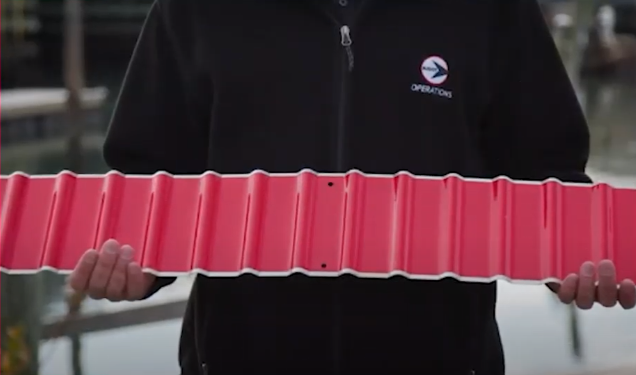
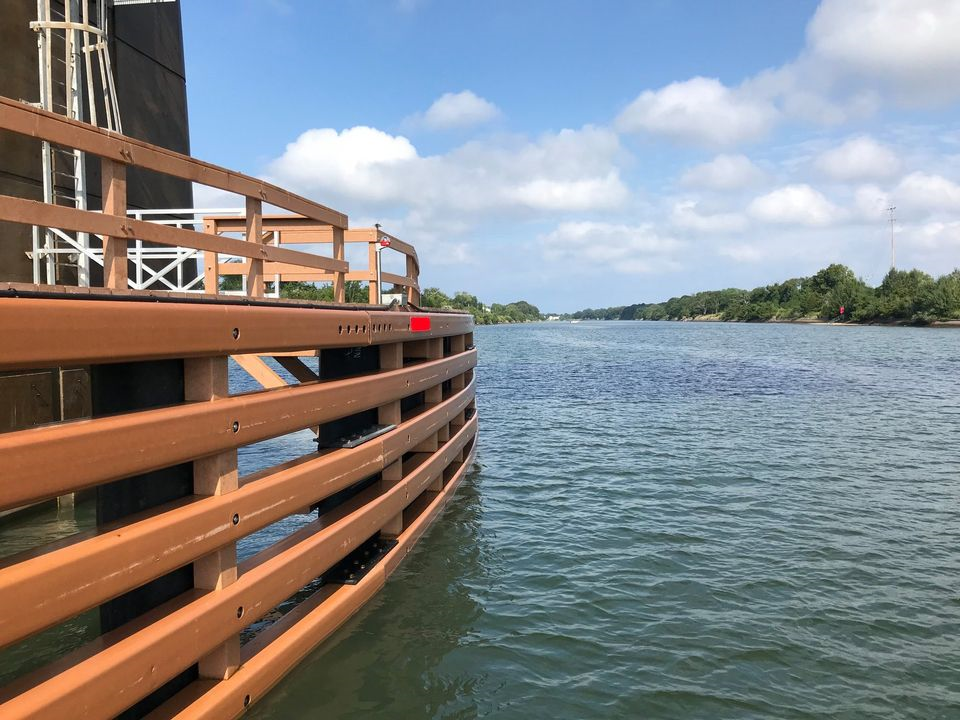
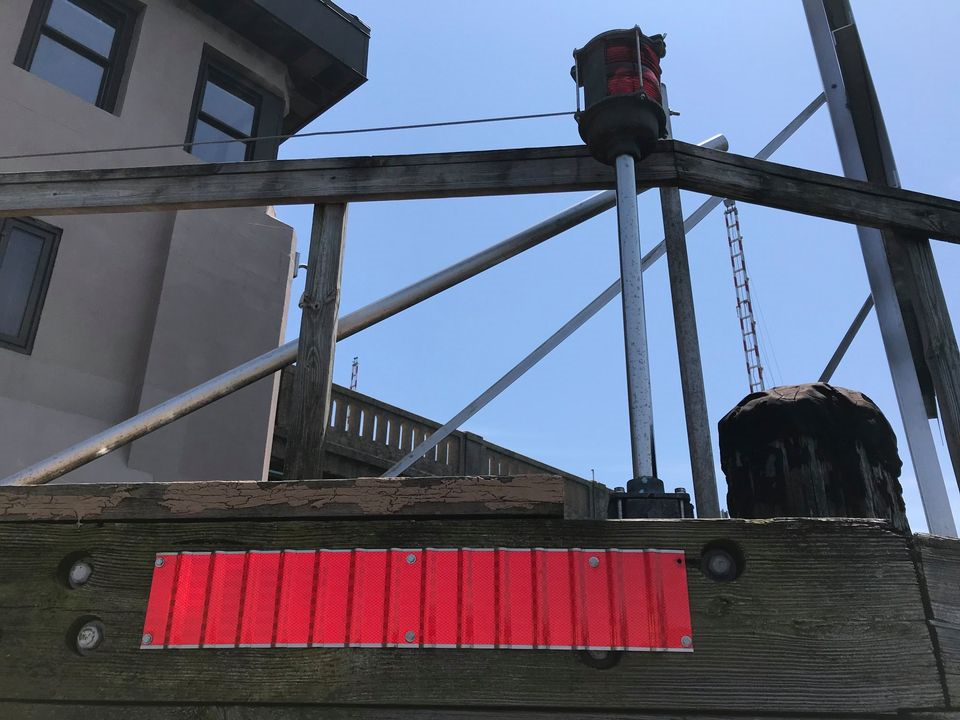
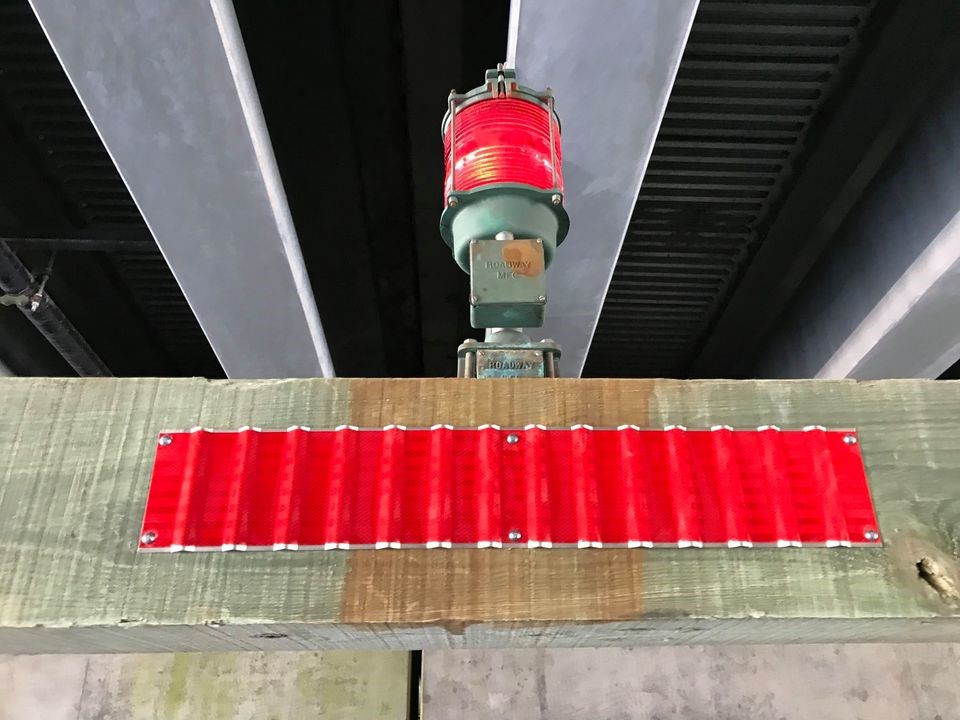
Marine Navigation Retroreflective Markers are an innovative addition to the traditional lights required by the U.S. Coast Guard (USCG) on bridge fenders. The State of New Jersey owns and maintains 65 bridges that cross navigable waterways. Lighting equipment is used on bridge fenders to aid navigation through the channels underneath the bridges. Any failure of these lights creates a safety hazard and requires emergency repairs. Upon detection of a light failure, a work order is issued by NJDOT for an emergency crew, incurring costs due to lost productivity and overtime pay. In addition, the USCG may impose a penalty of $25,000 per day per incident. The genius of the innovation is in the installation of retroreflective panels, typically used on highways, which are themselves inexpensive. As a backup for the navigation lighting, these panels maintain safety for boaters, and help to ensure the safety of repair crews as work can now be carried out during daylight hours rather than immediately — irrespective of daylight or harsh weather conditions. This cost-effective solution makes navigation safer and reduces the burden of maintenance. The USCG has approved NJDOT’s Marine Navigation Retroreflective Markers as a backup to the navigation lighting system.
The Marine Navigation Retroreflective Markers can easily be adopted by other NJ agencies and other state DOTs as backup lighting for navigating waterways under bridges.
Watch the video shared at the AASHTO awards to learn more about NJDOT’s Marine Navigation Retroreflective Markers.
Use of the marine navigation retroreflective markers can aid navigation
Use of the marine navigation retroreflective markers on bridges as backup navigation lighting
Use of the marine navigation retroreflective markers beneath bridges for better guiding boats
This Research to Implementation video presents an example of NJDOT-sponsored research and the effect such research has in addressing transportation-related issues within the State.
Reclaimed Asphalt Pavement (RAP) is material gathered through the milling and removal of existing pavement surfaces. In New Jersey, reuse of this material is restricted to inclusion in new asphalt pavements. NJDOT’s Bureau of Research supported a study that explored the environmental impacts associated with reuse of RAP in unbound applications.
The video summarizes the research and the resulting recommendations that have influenced legislation and helped frame discussions among various stakeholders concerning the beneficial uses of RAP.
New Jersey’s Department of Transportation is participating in a pilot study exploring a potential future transportation funding solution for the roads, bridges and public transit in New Jersey. The pilot study will examine whether mileage-based user fees (MBUF) offer a feasible alternative to the fuel tax, which is seeing declining revenues as more drivers shift to more efficient and electric vehicles.
The pilot study is taking place through a partnership of the New Jersey Department of Transportation and The Eastern Transportation Coalition. NJDOT is neutral about whether MBUF is the ultimate answer, but recognizes the importance of further studying MBUF in real-world pilots as a means to finding a realistic and effective solution to our long-term funding challenge.
NJDOT is seeking participants from the transportation community to help test drive new technology needed for a MBUF system and offer their insights. While the pilot study is currently underway, there is still time to enroll in the program.
Enrollment is easy and only requires a couple of steps to begin:
Step Two: Visit the Coalition’s MBUF website to begin enrollment.
Within a week of enrollment, you’ll receive a device that turns your car into a “smart car.” Just plug it in, drive for four months, and provide feedback via quick online surveys.
The Eastern Transportation Coalition has already conducted pilot studies for trucks and passenger vehicles. Findings from these pilot studies and other technical memoranda addressing such topics as administration and compliance, privacy, interoperability, equity and fairness can be found here.
The Eastern Transportation Coalition, formerly known as the I-95 Corridor Coalition, is a partnership of 17 states and the District of Columbia focused on connecting for solutions to support the economic engine of the U.S. The Coalition represents 40% of the U.S. population and GDP.
The Coalition is neutral regarding MBUF as the ultimate solution for transportation funding but wants to ensure that the voices of citizens along the Eastern Seaboard are part of the national discussion. Results from studies across the country will help policymakers decide on next steps.
The 22nd Annual NJDOT Research Showcase was an opportunity for the New Jersey transportation community to learn about the broad scope of academic research initiatives underway and share technology transfer activities being conducted by institutions of higher education partners and their associates. The annual event serves as a showcase to present the ongoing initiatives and benefits of the NJDOT Research program. This event was also the first Research Showcase conducted by webinar with sessions held from 9am-12pm on October 27, 28, and 29, 2020.
Each day's Research Showcase Program included presentations by university researchers, NJ agency representatives, and engineers offering their perspectives and fielding questions on topics including responses to the challenge of weather and climate change, emerging technologies such as smart mobility, and the effects of Covid-19 on transportation networks. These presentations were followed by poster sessions presenting research of students attending New Jersey’s universities and colleges.
DAY 1
On Day 1, the NJDOT Commissioner of Transportation, Diane Gutierrez-Scaccetti, provided opening remarks along with the Federal Highway Administration's Assistant Division Administrator in New Jersey, Valeriya Remezova. Both speakers noted NJDOT’s steps taken and plans for the future to promote resiliency.
A recording of the Day 1 presentations can be found here and to the right.
The keynote speaker was Gerald E. “Jerry” Buckwalter, Chief Operating and Strategy Officer of the American Society of Civil Engineers who presented the “ASCE Future World Vision.” Mr. Buckwalter described the ASCE role in imagining the future of cities, incorporating rapid developments in technology, alternative energy, climate change, materials, policy and funding, and demographics and urbanism. The project created five interactive scenarios of multi-dimensional city and neighborhood systems to adapt to changes over the next fifty years. These visions are intended to engage youth in thinking about engineering, spark public interest, provide a visual starting point for discussion, encourage cross-disciplinary collaboration and create a common language, and to foster innovation among university students.
Keynote presentation by Gerald E. Buckwalter, Chief Operating and Strategy Officer, American Society of Civil Engineers. Click for pdf
Amanda Gendek, Manager, NJDOT Bureau of Research announced several awards given in recognition of research, innovation and implementation efforts. Below is a listing of the award winners presented at this year's showcase:
2020 Outstanding University Student in Transportation Research Award – Laura Marques Soarces, Rutgers University (Energy Harvesting on New Jersey Highways)
2020 NJDOT Research Implementation Award – Yusuf Mehta, Rowan University (Environmental Impacts of Recycled Asphalt Pavement)
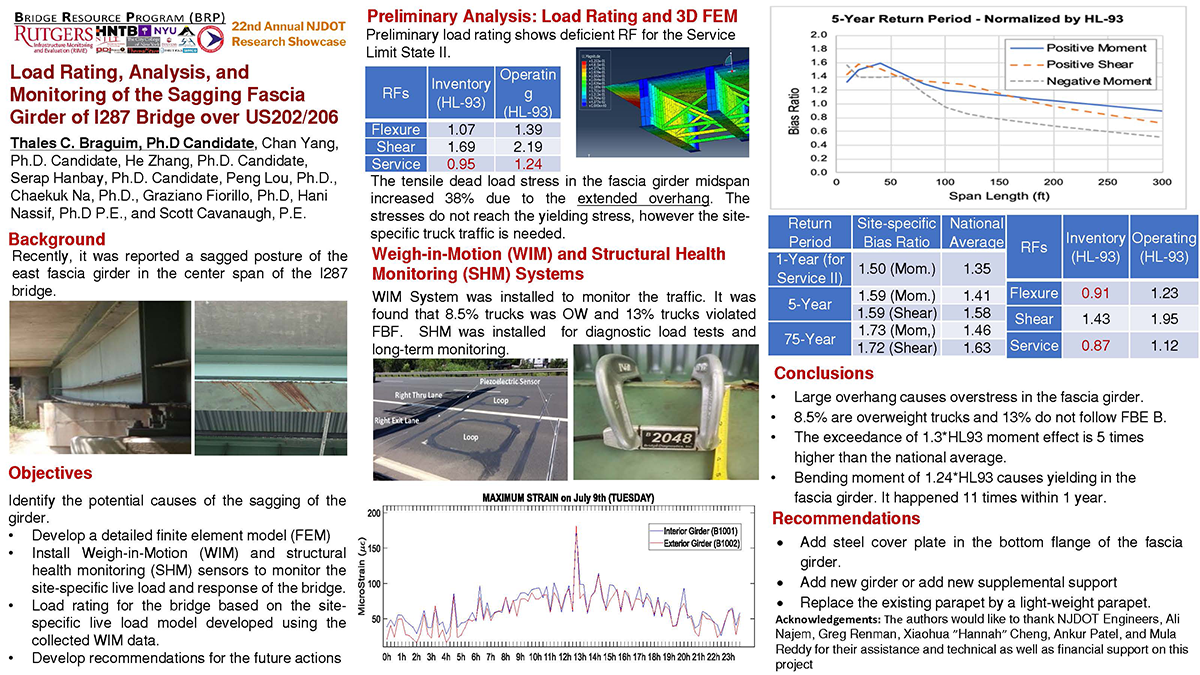
2020 Best Poster Award – Thales Couto Braguim, Rutgers University (Load Rating, Analysis, and Monitoring of the Sagging Fascias Girder of I-287 Bridge over US202/206) LINK
2020 NJDOT Build a Better Mousetrap Award – Scott Ainsley and Mark Crago (Anti-Jacknife Device)
The Build a Better a Mousetrap Award was given to Scott Ainsley and Mark Crago in NJDOT’s Operations Training Unit for their Anti-Jacknife Device. They developed this early warning device to prevent jackknifing and damage to trucks and trailers during new employee CDL training. The device increases cost savings by eliminating the need for repairs, and improves efficiency during new employee training (see videos below).
DAY 2 PRESENTATIONS
On Day 2, research presentations focused on resiliency themes, the economic impacts of Covid-19 on maritime trade and port commerce, and emerging smart mobility technologies.
A recording of the Day 2 presentations can be found here and to the right.
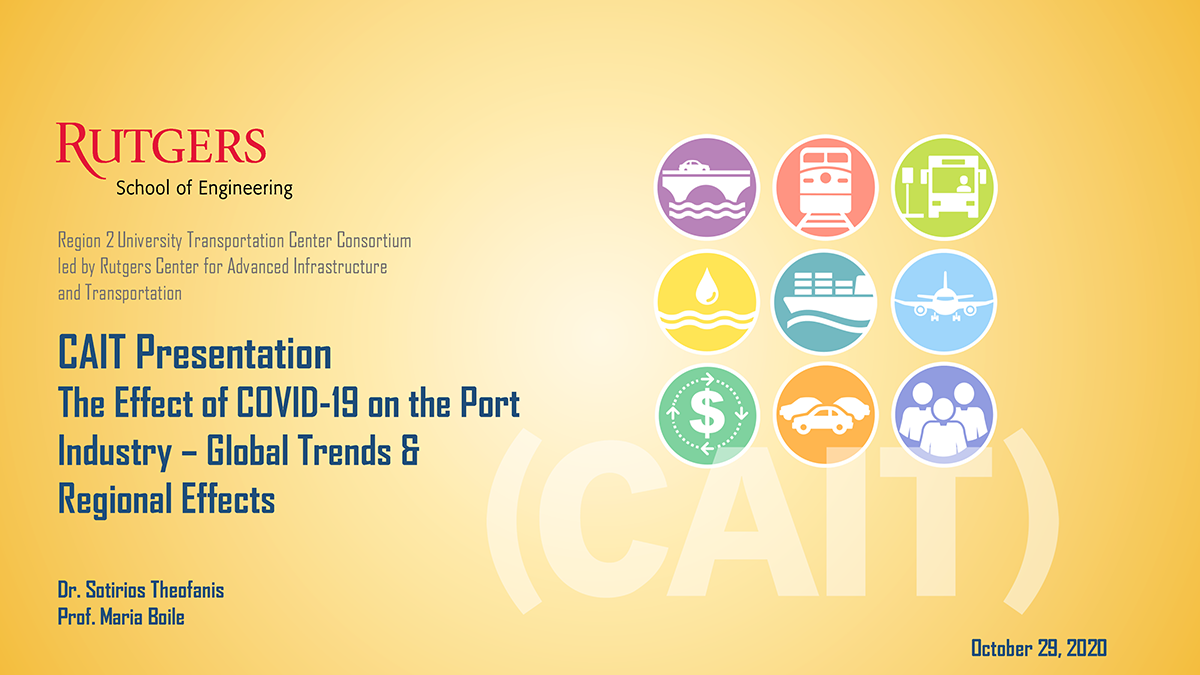
The Effect of Covid-19 on the Port Industry – Global Trends & Regional Effects, Sotiris Theofanis, PhD and Maria Boile, PhD (Rutgers University) LINK
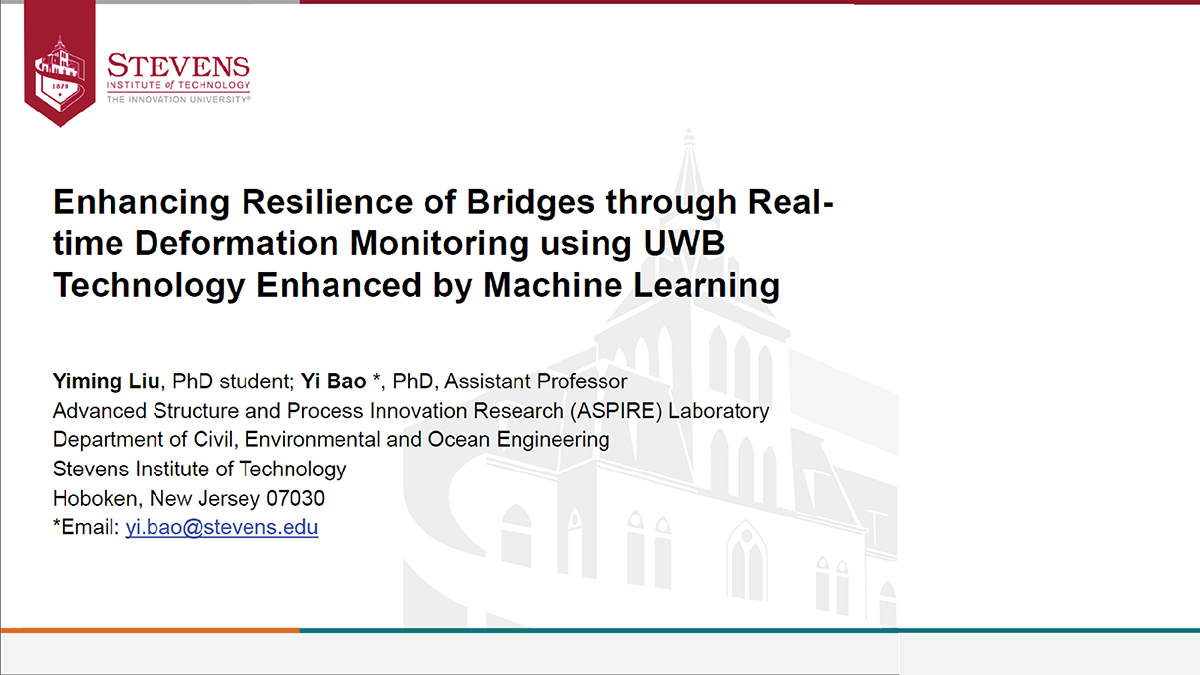
Enhancing Resilience of Bridges through Real-time Deformation Monitoring using UWB Technology Enhanced by Machine Learning, Yiming Liu (Stevens Institute of Technology) LINK
Coming Soon: NJDOT Flood Risk Visualization Tool, Jon Carnegie, AICP, PP (Rutgers University) LINK
New Jersey’s Climate Change Resilience Strategy, Dave Rosenblatt, Assistant Commissioner (New Jersey Department of Environmental Protection) LINK
New Brunswick Innovation Hub Smart Mobility Testing Ground Phase 1 Planning, Peter J. Jin, PhD and Ali Maher, PhD (Rutgers University) LINK
Improving Resilience, Safety, and Service Life of the Pulaski Skyway, Ruben Gajer, PE (Arora and Associates, PC) LINK
DAY 3 PRESENTATIONS
On Day 3, research presentations covered several topics, including transportation-related health stressors relationship on Covid-19 and energy, durability, mobility and safety topics in transportation.
A recording of the Day 3 presentations can be found here and to the right.
Exploring the Impacts of VMT induced PM2.5 on the Rate of COVID-19 Infection, Yeganeh Hayeri, PhD and Hojat Behrooz (Stevens Institute of Technology) LINK
Energy Harvesting from Roadways and Bridges: Opportunities and Challenges, Hao Wang, PhD (Rutgers University)
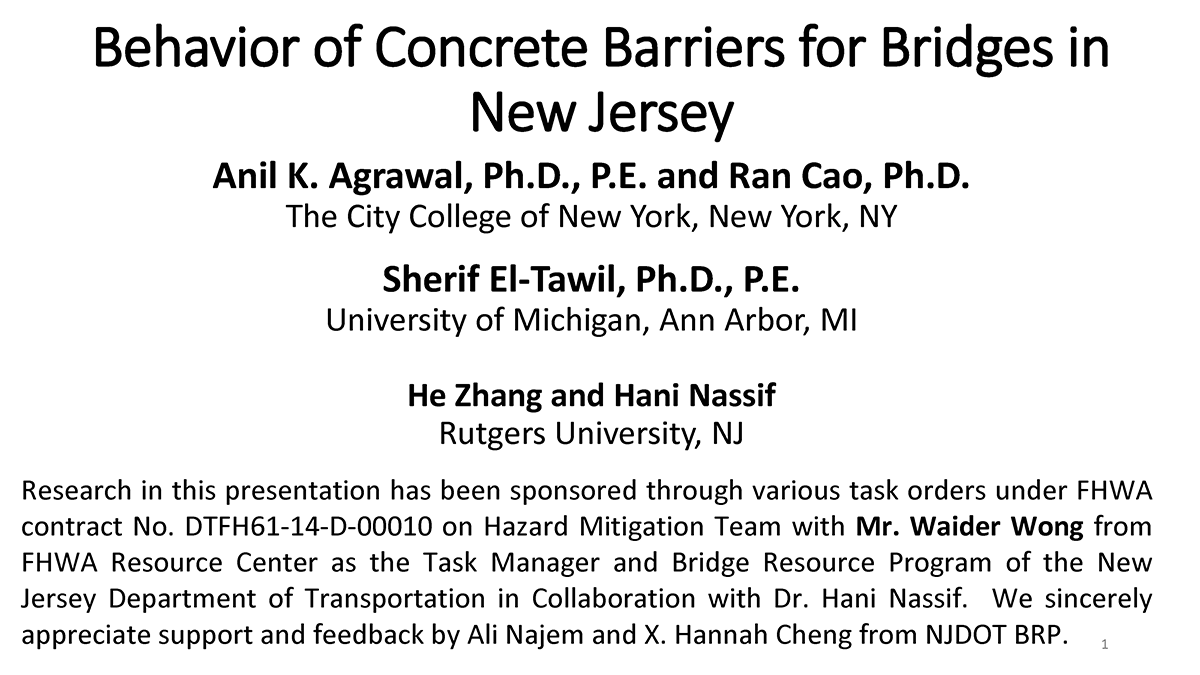
Behavior of Concrete Barriers for Bridges in New Jersey, Anil Agrawal, PhD (The City College of New York) LINK
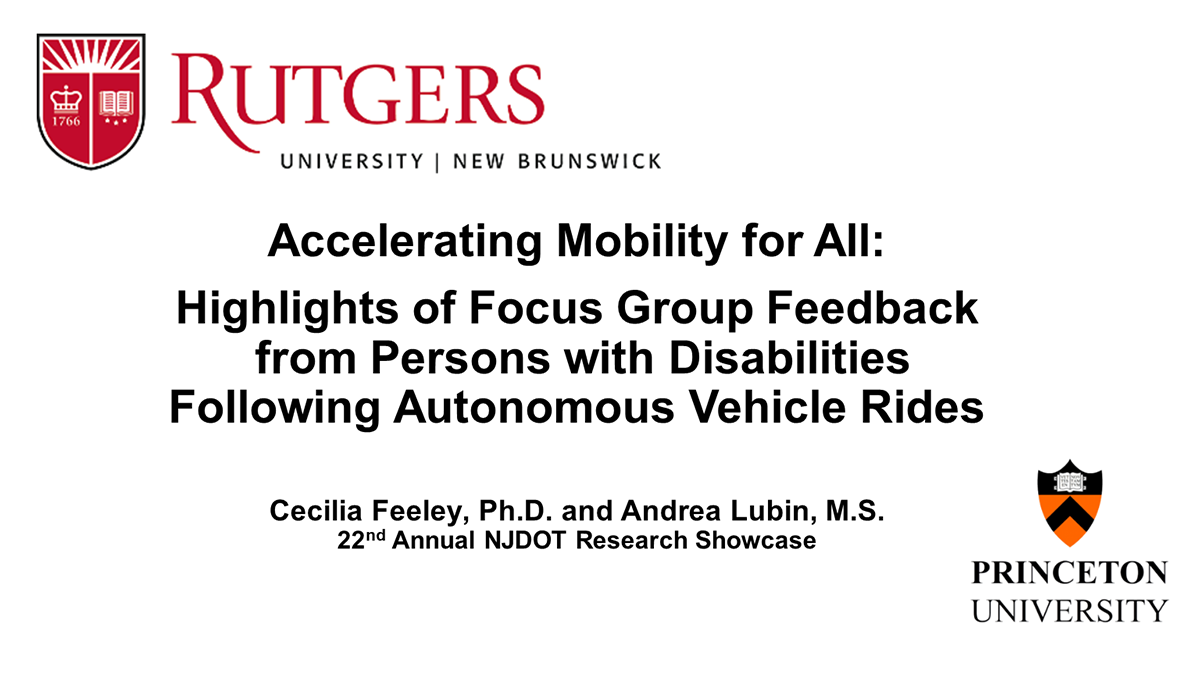
Accelerating Mobility for All: Analysis of Focus Group Feedback from Persons with Disabilities Following Autonomous Vehicle Rides, Cecilia Feeley, PhD and Andrea Lubin (Rutgers University) LINK
Development and Evaluation of a Realtime Truck Detection Method Using Deep Learning Based Object Recognition Techniques for Truck Parking Information System, Joyoung Lee, PhD (New Jersey Institute of Technology)
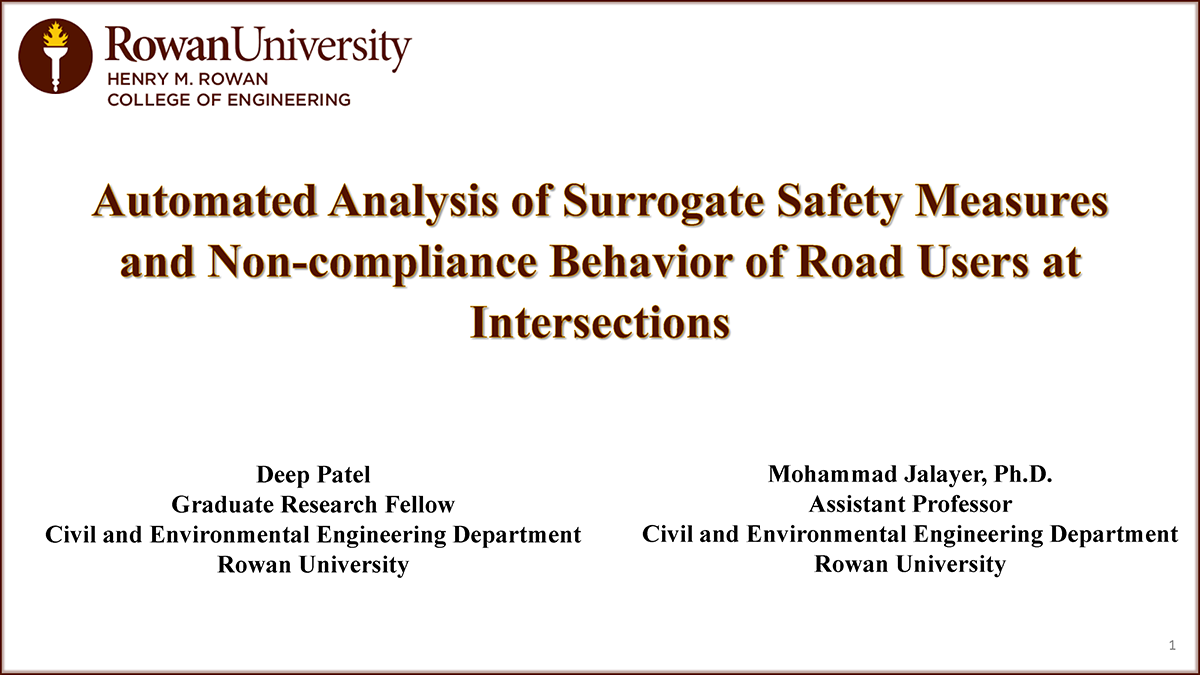
Automated Analysis of Surrogate Safety Measures and Non-compliance Behavior of all Road Users at an Intersection, Deep Patel and Mohammad Jalayer, Ph.D (Rowan University) LINK
POSTER SESSIONS
Each day students and researchers at New Jersey’s colleges and universities presented posters describing their methods and findings on ongoing and recently completed research and responded to questions by attendees. (Click on images for links to posters.)
Optimized Speed Profiles for Sustainable Train Operation with Regenerative Braking – Leon Allen and Steven Chien, NJIT
Load Rating, Analysis, and Monitoring of the Sagging Fascia Girder of I-287 Bridge over US202/206 – Thales Couto Braguim, Rutgers University
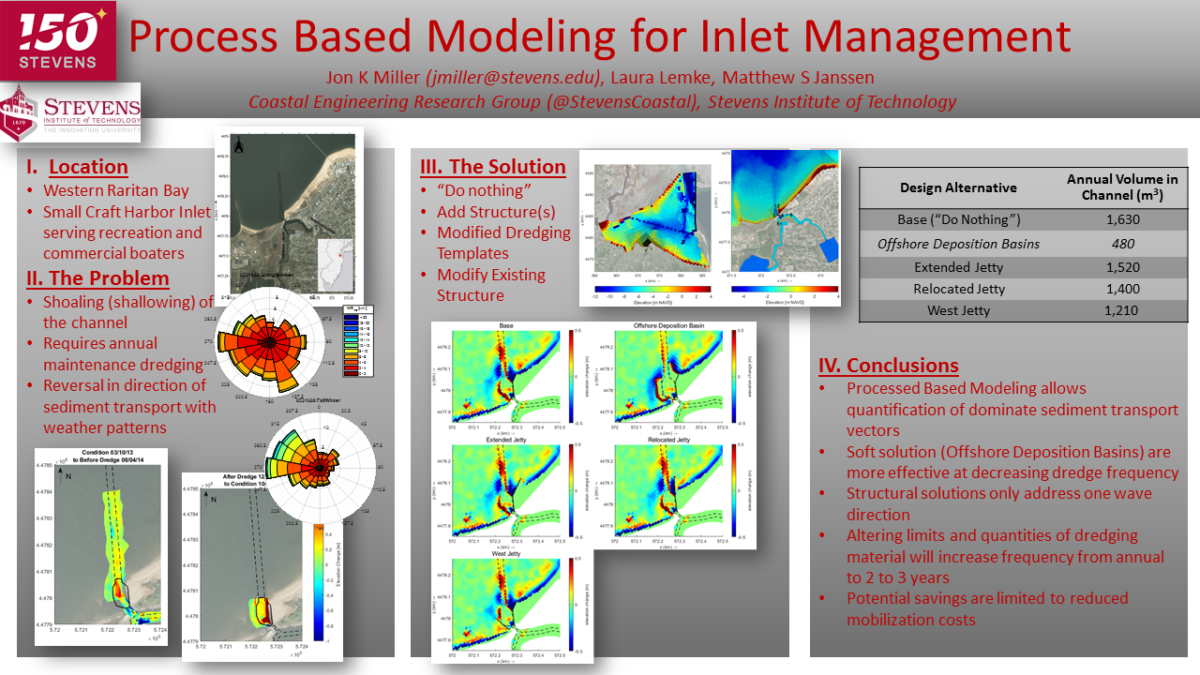
Process-Based Modeling for Inlet Management – Jon K. Miller, Laura Lemke, Matthew S. Jannsen, Stevens Institute of Technology
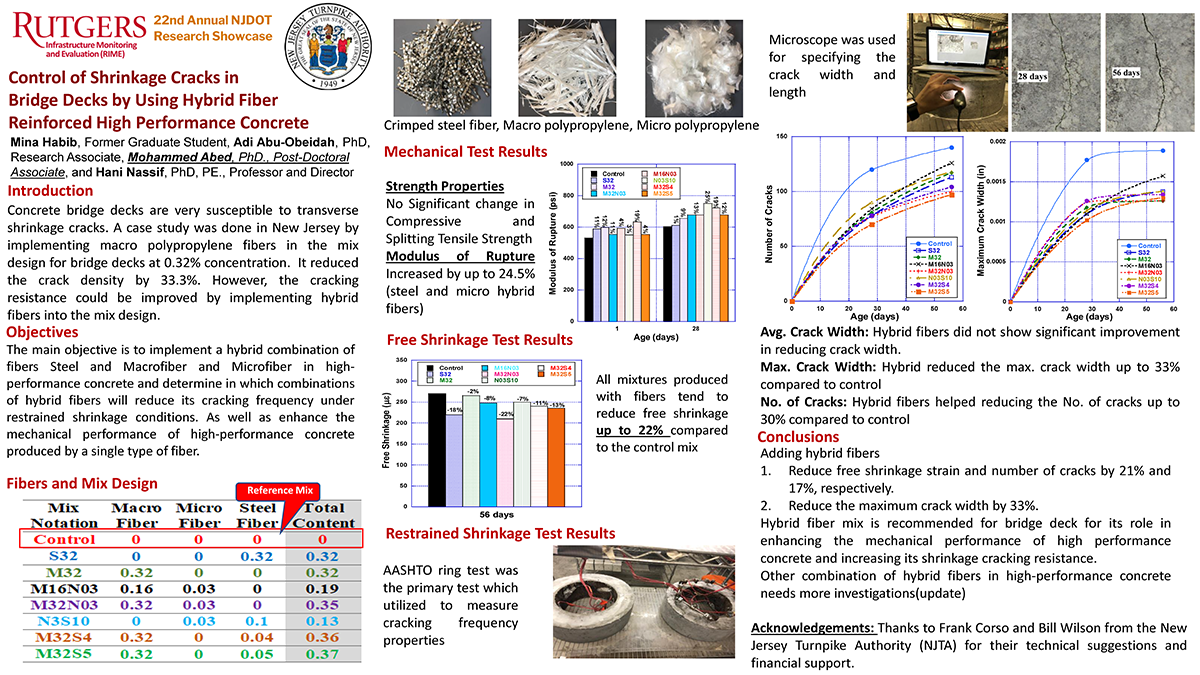
Control of Shrinkage Cracks in Bridge Decks by Using Hybrid Fiber Reinforced High Performance Concrete – Mina Habib
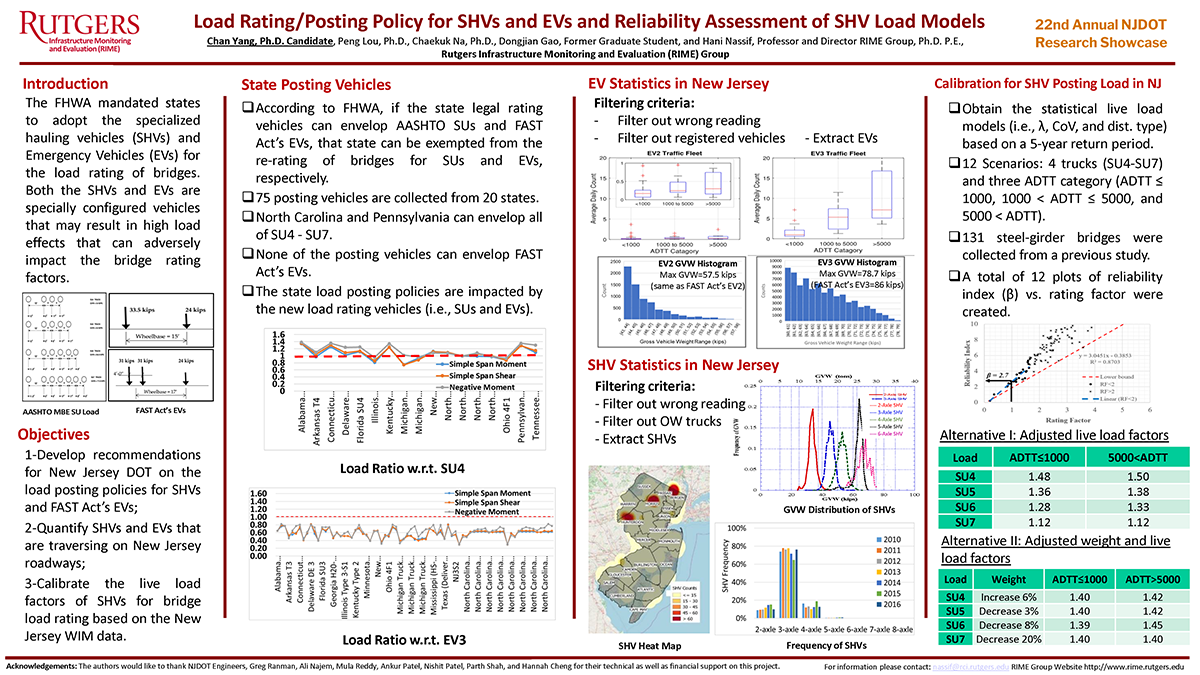
Load Rating/Posting Policy for SHVs and EVs and Reliability Assessment of SHV Load Models – Chan Yang, Peng Lou, Chaekuk Na, Dongjian Gao, Rutgers University
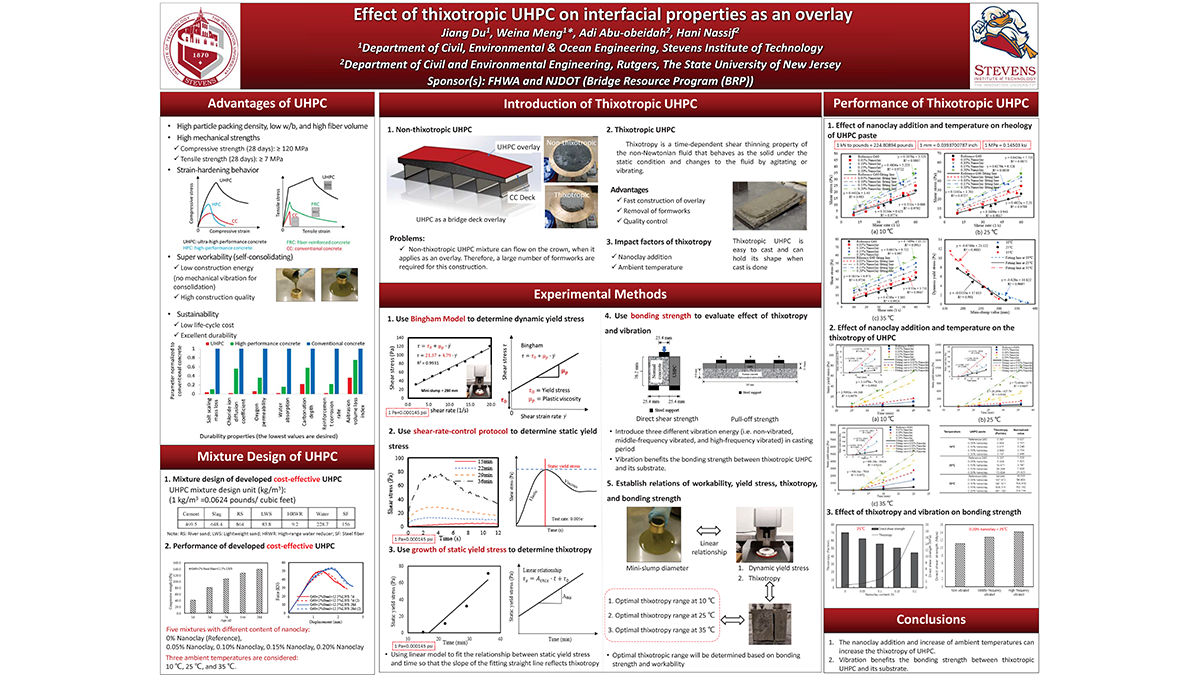
Effects of Thixotropic UHPC on Interfacial Properties as an Overlay – Jiang Du, Weina Meng, Adi Abu-obeidah, Hani Nassef, Stevens Institute of Technology
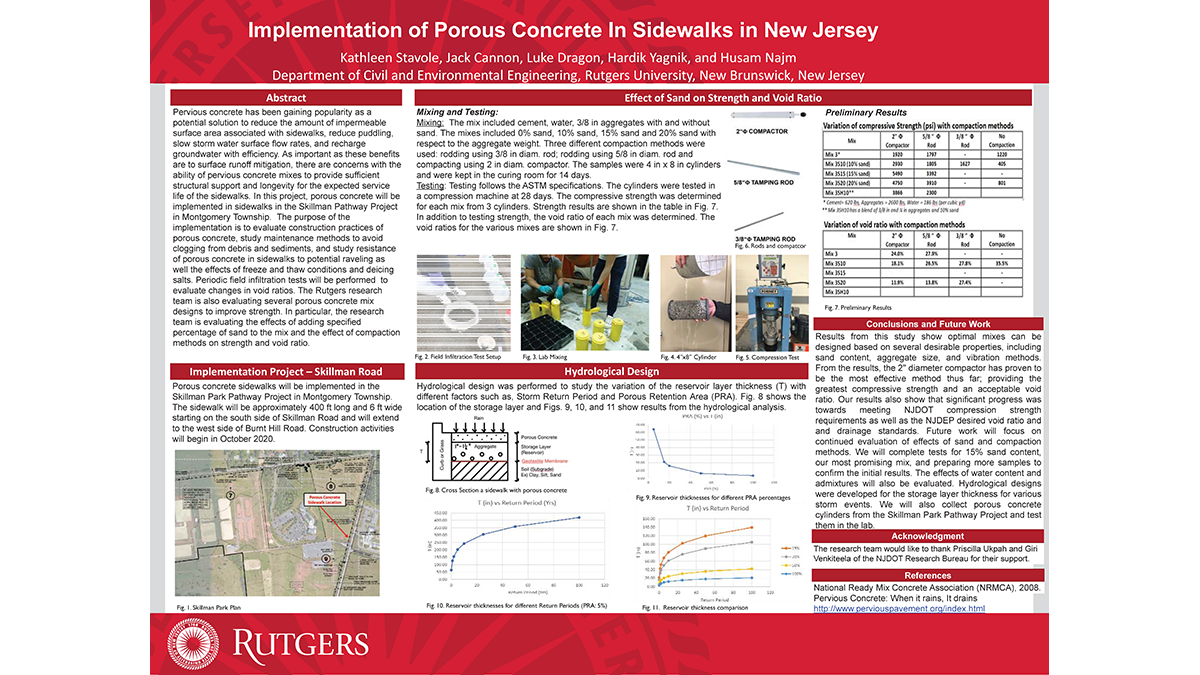
Implementation of Porous Concrete in Sidewalks in New Jersey – Kathleen Stavole, Jack Cannon, Luke Dragon, Hardik Yagnik, Husam Najm, Rutgers University
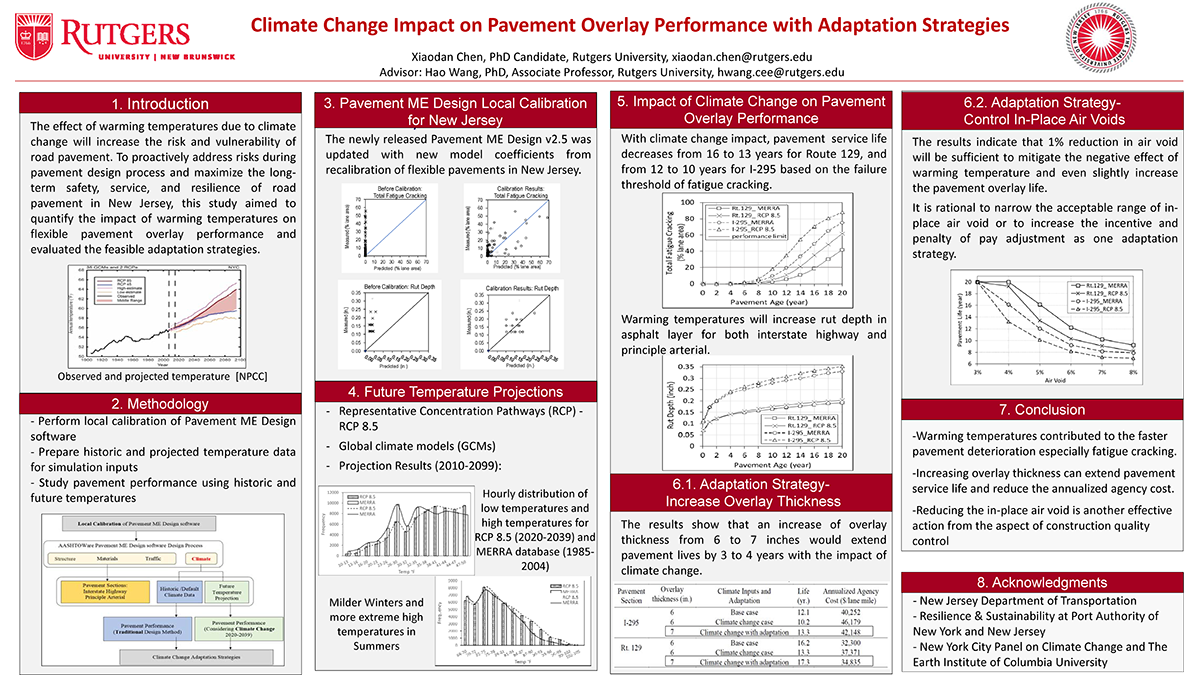
Climate Change Impact on Pavement Overlay Performance with Adaptation Strategies – Xiaodan Chen, Rutgers University
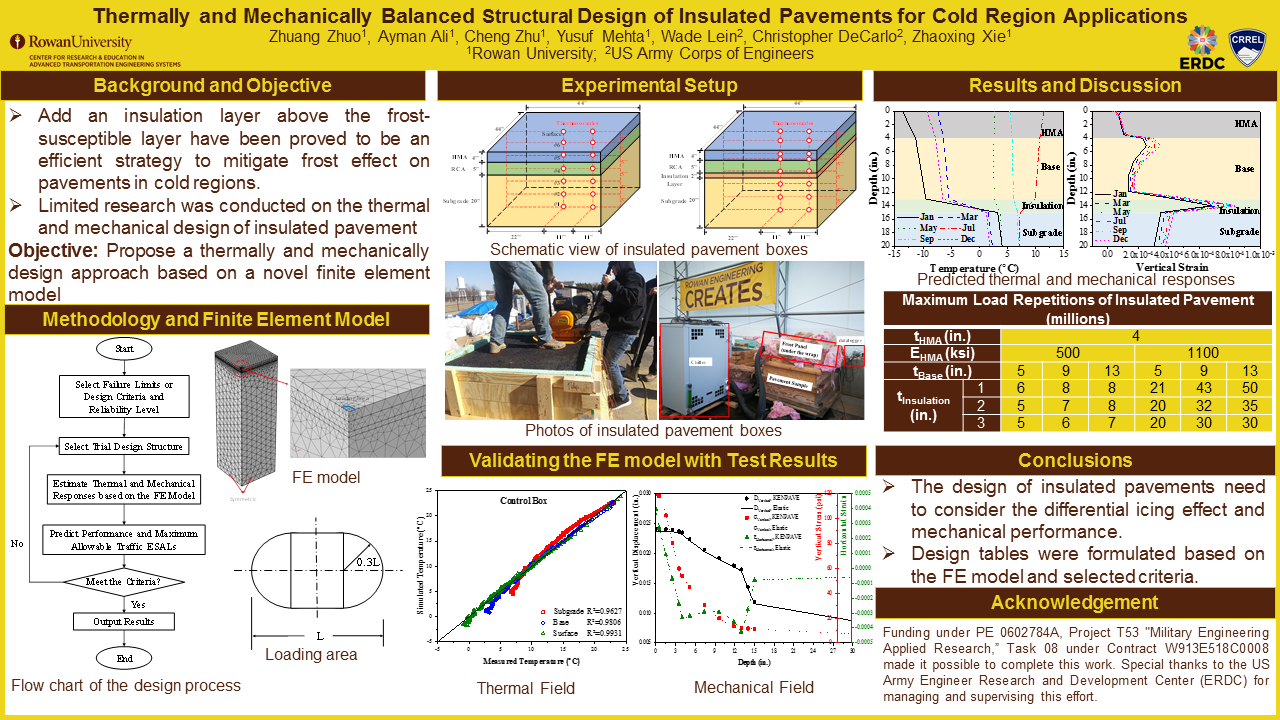
Thermally and Mechanically Balanced Structural Design of Insulated Pavements for Cold Region Applications – Zhuang Zhuo, Ayman Ali, Cheng Zhu, Yusuf Mehta, Wade Lein, Christopher DeCarlo, Zhaoxing Xie, Rowan University & the US Army Corps of Engineers
The 22th Annual NJDOT Research Showcase was organized and sponsored by the NJDOT Bureau of Research in partnership with the New Jersey Local Technical Assistance Program (NJLTAP) at Rutgers Center for Advanced Infrastructure and Transportation (CAIT) and co-sponsored by the Federal Highway Administration.
NJDOT’s Traffic Incident Management Program offers training and resources to improve the coordinated response to traffic incidents. Source: NJTIM website
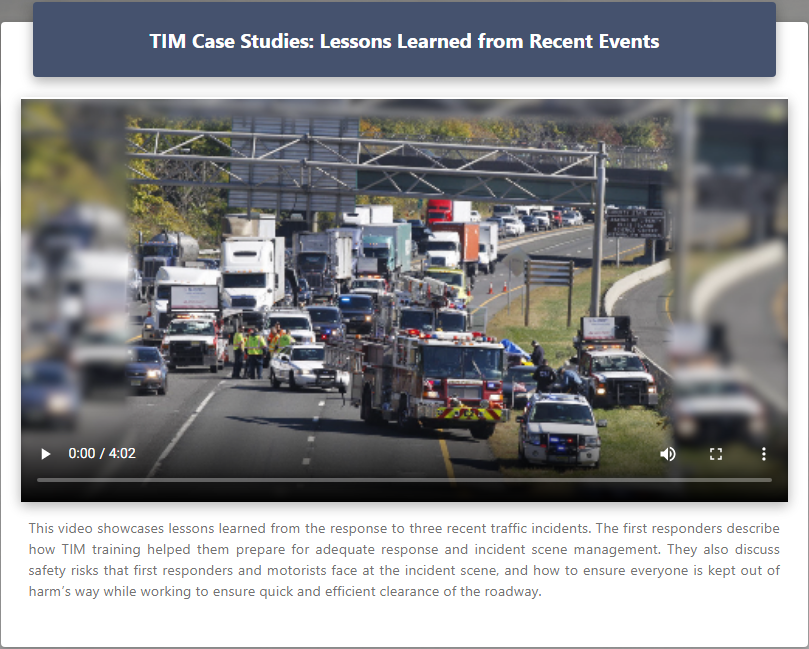
NJDOT’s New Jersey’s Traffic Incident Management (TIM) program consists of a planned and coordinated multi-disciplinary process to detect, respond to, and clear traffic incidents so that traffic flow may be restored as safely and quickly as possible after an incident. According to the 2015 State of New Jersey Traffic Incident Management Strategic Plan, about half of all traffic congestion is caused by temporary, one-time occurrences, such as crashes, disabled vehicles, spilled cargo, highway maintenance and reconstruction, adverse weather, and planned special events. These occurrences reduce roadway capacity, disrupt the normal operation of the transportation system, increase the risk of secondary crashes, and result in lost time and productivity, increased cost of goods and services, negative impacts on air quality and the environment, and reduced quality of life and motorist satisfaction.
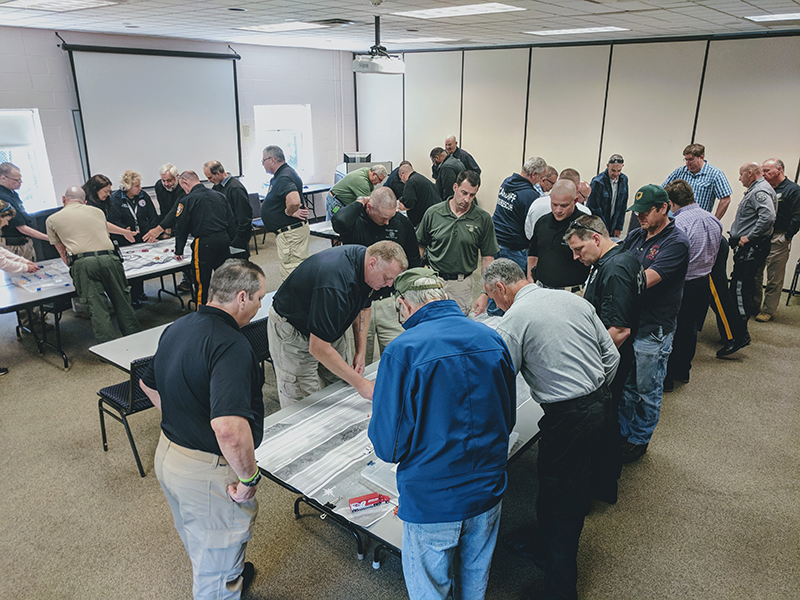
Training classes include incident resolution exercises. Source: NJTIM website
By reducing the duration and impact of traffic incidents, effective traffic incident management practices improve the safety of crash victims, other motorists, and emergency responders. TIM practices are designed to reduce the time to detect, respond to, investigate, and safely clear the incident, to safely manage personnel and equipment at the site, provide timely and accurate information to the public, and to manage affected traffic until normal conditions are restored. Stakeholders in the Traffic Incident Management program include federal, state, and local agencies and private sector partners including emergency medical services (EMS), fire and rescue, law enforcement, transportation agencies, medical examiners and coroners, hazardous materials contractors, towing and recovery, emergency management, public safety communications, and traffic information media.
The FHWA’s Every Day Counts (EDC) program, in cooperation with the second Strategic Highway Research Program (SHRP2), offered the first national traffic incident management process and training program as an innovation under EDC-2 in 2013-2014. First offered in 2010, NJDOT’s classes in TIM predated the FHWA EDC initiative. The NJ TIM Responder Training provides interactive, hands-on incident resolution exercises to help participants learn to coordinate incident response activities and optimize operations in the field. The training supports development of a unified practice among all stakeholders. NJDOT has continued to train in TIM during the pandemic and, as of September 1, 2020, the program has trained 29,798 incident responders.
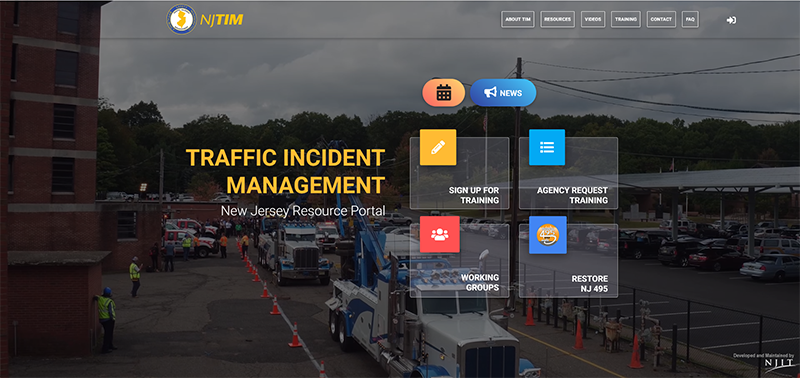
NJDOT and the ITS Resource Center at NJIT have updated the NJTIM website. Source: NJTIM website
In alignment with the 2015 Strategic Plan, NJDOT and the ITS Resource Center at the New Jersey Institute of Technology, developed the NJ TIM website in 2016 to provide support to the TIM program. Recently, they have modernized the website through the addition of new content, including videos and other resources such as case studies and training recaps. A schedule of virtual trainings, and registration for individual and group training, are available. The website provides links to the Strategic Plan and Safety Guidelines for Emergency Responders, as well as contact information for all federal, state, county, and local law enforcement agencies operating in the state.
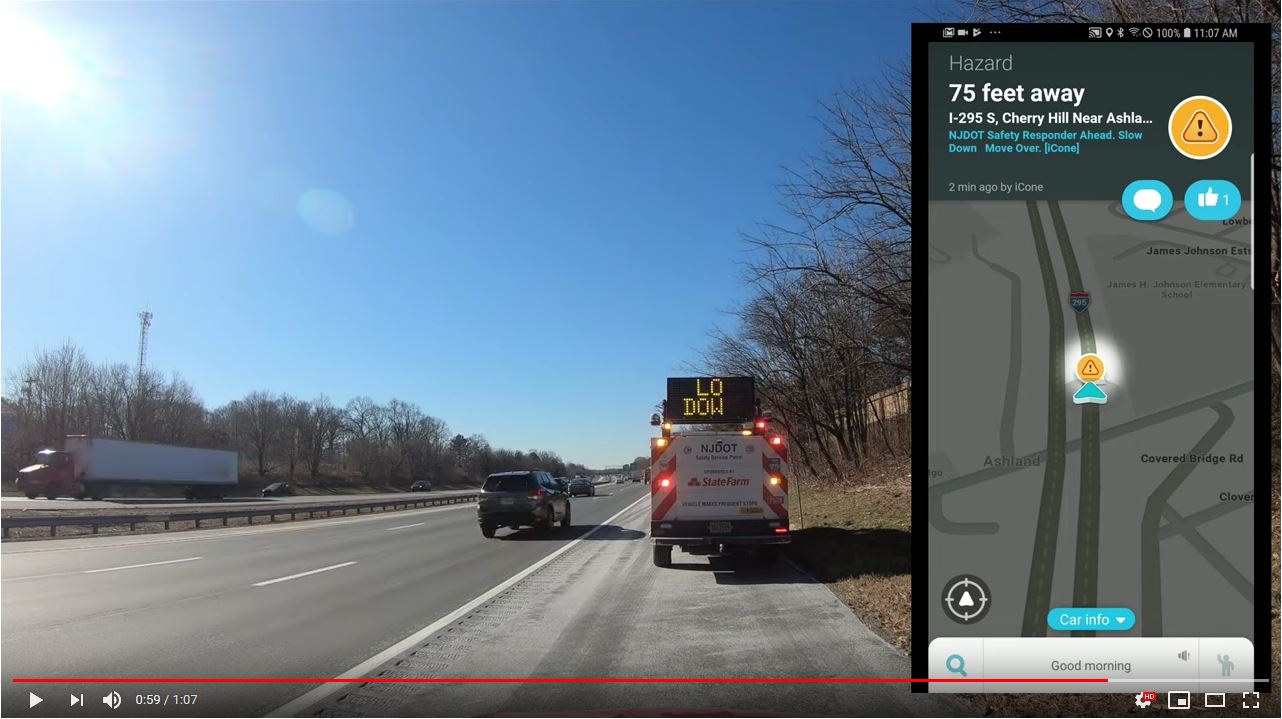
Video screenshot of hazard display message received by motorists. Source: NJDOT
Through EDC-4, FHWA promoted the use of data to improve traffic incident management. NJDOT is increasingly looking to technology to improve safety at incident sites. A pilot study looked at the effectiveness of using connected vehicle technology on 32 safety service vehicles to alert drivers to the presence of safety service patrol (SSP) workers via the mobile navigation app Waze. NJDOT established a Computer-Aided Dispatch (CAD) Integration Working Group to develop a plan for CAD integration among New Jersey agencies and other organizations. Using the OpenReach system, NJDOT has implemented the FHWA key performance measures: roadway clearance time; incident clearance time; and number of secondary crashes. Traffic incident management data sharing between the NJDOT and law enforcement systems is expected to decrease incident response times, properly capture the incident timeline, and improve the traffic incident management process. More information on these efforts can be found at the NJDOT Technology Transfer website.
On October 7, 2020, NJDOT hosted a Lunchtime Tech Talk! Webinar on the Analysis of Local Bus Markets with Deva Deka, Ph.D., Assistant Director, Research, at Rutgers – Alan M. Voorhees Transportation Center, and Susan O’Donnell, Senior Director, Business Analysis and Market Research at NJ TRANSIT. Dr. Deka began the presentation with a general description of the NJ TRANSIT system that operates approximately 250 bus routes throughout New Jersey. Bus riders constitute almost 60 percent of all riders using NJ TRANSIT services, including commuter rail and light rail. For many New Jersey residents, those buses are essential for meeting almost all daily travel needs.
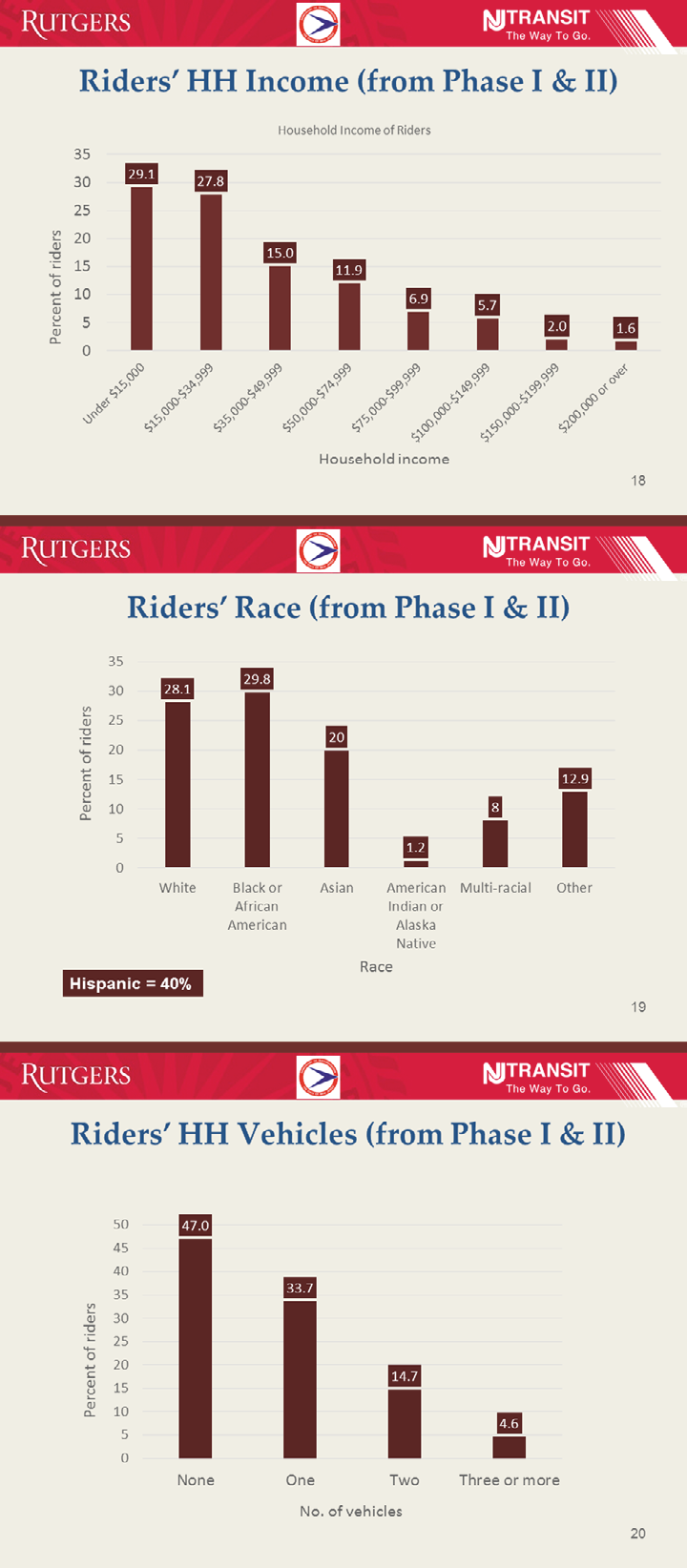
Dr. Deka provided a profile of the demographics of bus users, including household income, race, and vehicle ownership.
For the past five years, the Alan M. Voorhees Transportation Center of Rutgers University has been conducting onboard surveys of bus riders in different parts of New Jersey for projects funded by the NJDOT Bureau of Research and sponsored by NJ TRANSIT. Dr. Deka, the Principal Investigator for these survey studies, presented the bus survey methodology, and key findings. He described the questionnaire design, survey scheduling, training of surveyors, and the process of data collection, and the post-survey process that has involved data cleaning and weighting, and analysis. Over the five years, the project has generated clean data for over 15,000 riders.
Dr. Deka gave an overview profile of bus rider characteristics and trip characteristics found from the survey research. The survey showed that riders are predominantly Hispanic and/or African-American, lower-income, from households with no car or one car, and dependent on the bus system. The data support the essentiality of bus services for zero-car households and inform analyses of the broader impacts of bus services such as decreases in traffic delays and reductions in greenhouse gas emissions.
In the second half of the presentation, Ms. O’Donnell described the use of the survey data by NJ TRANSIT for planning purposes. The data supports travel demand modeling which replicates existing conditions and predicts future conditions to inform roadway projects and transit projects. This information is shared with New Jersey’s three Metropolitan Planning Organizations, the Port Authority of New York and New Jersey, and the New York Metropolitan Transportation Council. Current data is required in transit grant applications, and contributes to studies related to access to transit, corridors, intermodal systems, and transit oriented development.
To fulfill the agency’s obligations under Title VI of the Civil Rights Act of 1964, NJ TRANSIT uses the data to perform an equity analysis to evaluate the effect of fare changes or service changes on low-income populations and minority populations, and to provide data to help in developing a language assistance plan for Limited English Proficiency populations.
In addition, NJ TRANSIT uses the data when working with advertisers that want to target their message efficiently to specific demographic groups.
The agency’s Newark Bus System Redesign Project will use the data collected in fall 2019 to align and modify bus routes and explore service to new areas. This is the first, and largest, of multiple systems to be evaluated to bring the agency’s entire bus system up to date.
In closing, Ms. O’Donnell presented an update on bus use during the pandemic based on surveys given during April and June. The data shows how important the bus system has been to essential workers.
Following the presentation, the Dr. Deka and Ms. O’Donnell responded to questions asked through the chat feature:
Q. What was the number of questions asked on the survey and what incentives were offered? A. The survey comprised about 30 questions. Incentives helped increase interest in the surveys and respondents had a chance of winning 1 of 5 $100 gift cards.
Q. Did you consider using IPads rather than paper-based intercept surveys? A. Dr. Deka noted that they did consider them, but use of IPads limits the number of surveys that can be collected at one time. The surveyor has to stay with the individual using the IPad, and cannot approach other riders at the same time, limiting the efficiency of the survey-taker. Dr. Deka also referenced a Mineta Transportation Institute report that compared data quality and costs for different approaches to on-board transit passenger surveys that found efficiencies with the paper-intercept approach for bus users. Ms.O’Donnell noted that this technology might work at a station or on a platform because a number of surveyors can be located in the same place but is difficult to use on a crowded bus. During the pandemic, IPads probably could not be used due to safety concerns with touching and handling equipment.
Q. What are typical variables used to weight the data to the total ridership? A. The sample is weighted by direction of the bus, time of day, and the run. A trip is from an origin to the destination and all trips combined is a run. They do not weight the sample by demographic variables or geography because they do not have solid information on the total transit user “universe” population related to these variables.
Q. Did you compare rider survey results by types of service area? A. No. While there are some suburban routes if you segment or categorize by origins, such as Morristown, almost all routes are generally very urban. It would be possible to use the data to compare by counties.
Q. What is the delay imposed by traffic congestion on buses? A. Traffic impacts have been an issue that has been looked at by traffic engineers at Rutgers – CAIT some years ago. They collected data traffic signal timings at intersections that the bus traveled through and applied VISSIM for simulations. Dr. Deka said that he could connect anyone interested with the detailed technical methods that the researchers used on that traffic impact study, if they’re interested.