
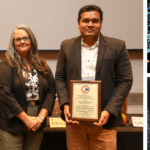
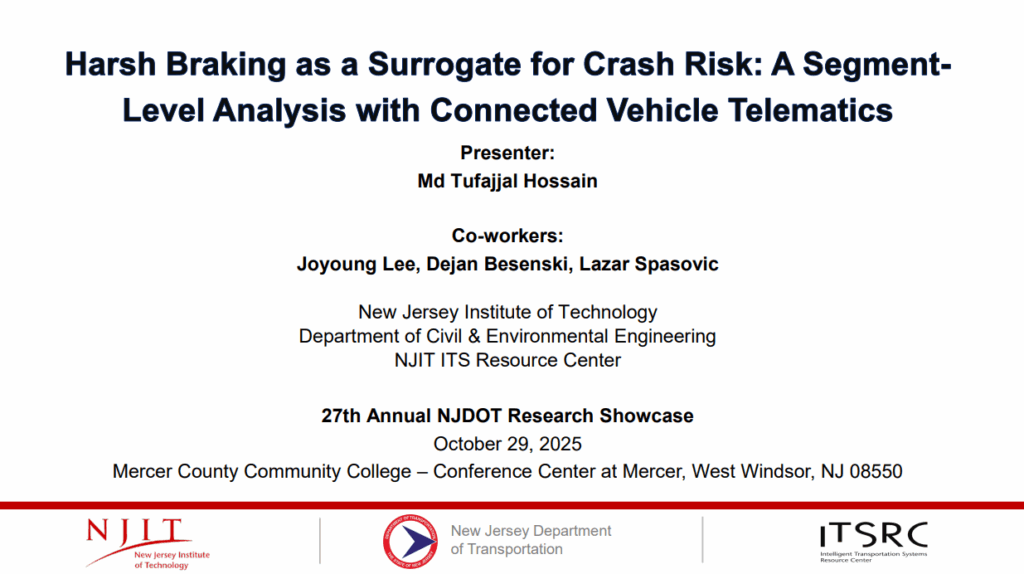
2025 NJDOT Research Showcase Poster Award Winner Md Tufajjal Hossain discusses how leveraging connected-vehicle telematics and machine learning can proactively identify high-risk roadway locations to prevent crashes before they occur.
Q. Could you share a bit about your educational and research experience and what led you to pursue PhD research at NJIT?
A. First, thank you for the opportunity to speak with you today. I am happy to share a bit about my background.
I completed my bachelor’s degree at Pabna University of Science and Technology in Bangladesh with a major in Urban and Regional Planning. During my undergraduate studies, I took a required course on transportation planning and engineering where I worked on projects involving traffic surveys and origin-destination analysis. That course sparked my interest and after the course finished I met with the instructor to express my strong desire to pursue a career in this field.
He helped introduce me to the field and I became involved in research and gradually developed an interest in intelligent transportation systems. I was particularly interested in applying machine learning, artificial intelligence, statistical analysis, and connected vehicle data to improve safety and operations in the transportation engineering field.
When I learned about the Intelligent Transportation System Resource Center (ITSRC) at NJIT, I was drawn by its ability to support this innovative research. Additionally, the partnership with NJDOT allows ITSRC to focus on applying real-world research.
ITSRC provides access to technical data, state-of-the-art sensors and data sources and high-performance computing resources, which motivated me to pursue my PhD at NJIT.
Q. You recently received the 2025 Research Showcase Poster Award for your work using harsh braking data to identify crash risk. What motivated you to explore this topic?
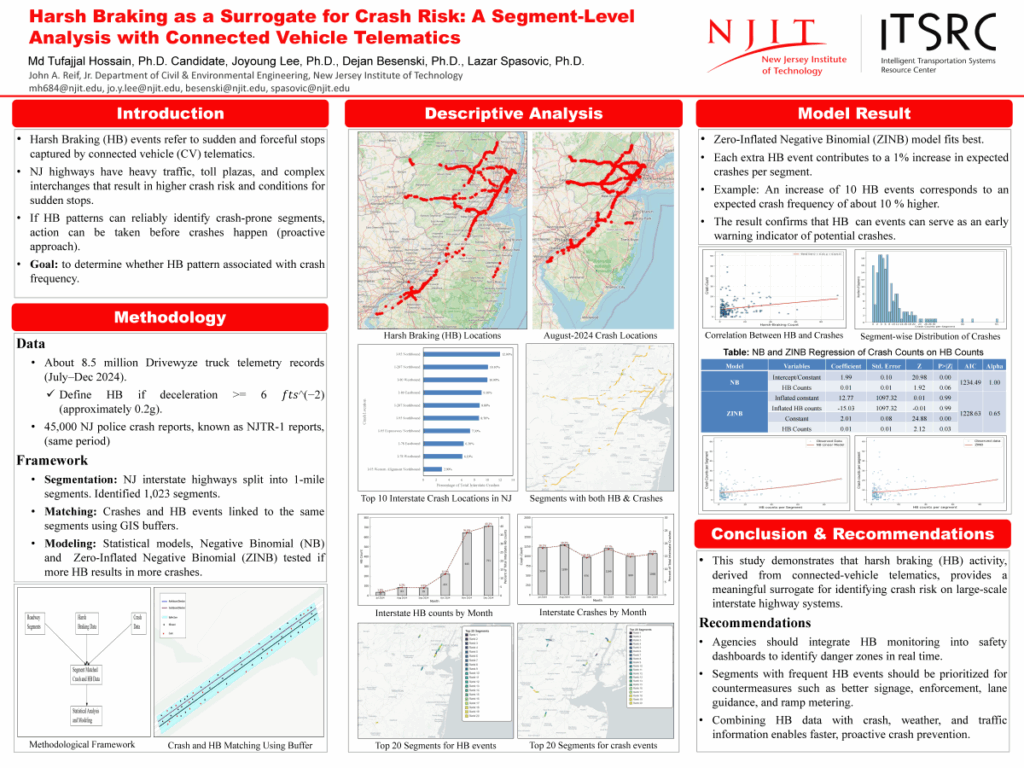
A. What motivated me to explore this topic is the limitations of existing literature on traditional crash analysis. Most research utilizes historical crash data, which is reactive and not as adaptive to new conditions. I was interested in finding a way to identify risky roadway locations before any serious crashes happen.
Harsh braking events captured from connected-vehicle data reflect sudden driver reactions to unsafe conditions and occur significantly more often than crashes. I saw strong potential in using these events as an early warning signal to identify areas with a high crash risk.
Q. Your study calculated harsh braking events using connected vehicle telematics. Could you describe how you identified those events and the statistical models you used to evaluate their relationship to crash risk?
A. I performed preliminary statistical analysis, a literature review, and reviewed several DOT reports. Most previous DOT studies define harsh braking using a threshold of 0.2 g, approximately 6 ft/s2. To remain consistent with these prior efforts, I adopted the same threshold in this study.
After defining harsh braking events, we mapped both the harsh braking data and crash data across one-mile segments on the New Jersey highway network. Additional filtering was applied to accurately capture both harsh braking events and crashes. We then conducted the analysis using statistical count models. To address that most roadway segments had zero crashes and the crash data was over-dispersed, we applied a Negative Binomial model and a Zero-Inflated Negative Binomial model.
Q. What challenges did you encounter during the research—whether in accessing telematics data, processing it, or conducting the analysis?
A. I would first like to thank the Mobility and Operations team at NJDOT, especially Sal Cowan, Vandana Mathur, Thomas Murphy and Konstantinos Kyros, for their support on this project. Additionally, I thank ITSRC at NJIT for providing me with the opportunity to work on this project. The Mobility team at NJDOT made it easy for us to access the Drivewyze data, and their support helped us examine whether this data could be used to identify effective countermeasures to reduce harsh braking and crash risk.
Beyond data access, one of the main challenges in this research was working with large and complex telematics data. The raw data included over eight million records and required careful data cleaning to remove missing values and ensure consistency in speed, location and acceleration information.
Accurately matching harsh braking events and crash events with the correct one-mile segments presented another challenge. After matching the one-mile segments, we found some discrepancies, which required manual filtering.
Lastly, we faced a challenge when selecting the appropriate statistical model. Crash data are highly variable and include many zero values, so we needed models that could properly handle over-dispersion and excess zeros.
Q. What were the major findings of the study, and what do you think is most important for practitioners to take away from your results
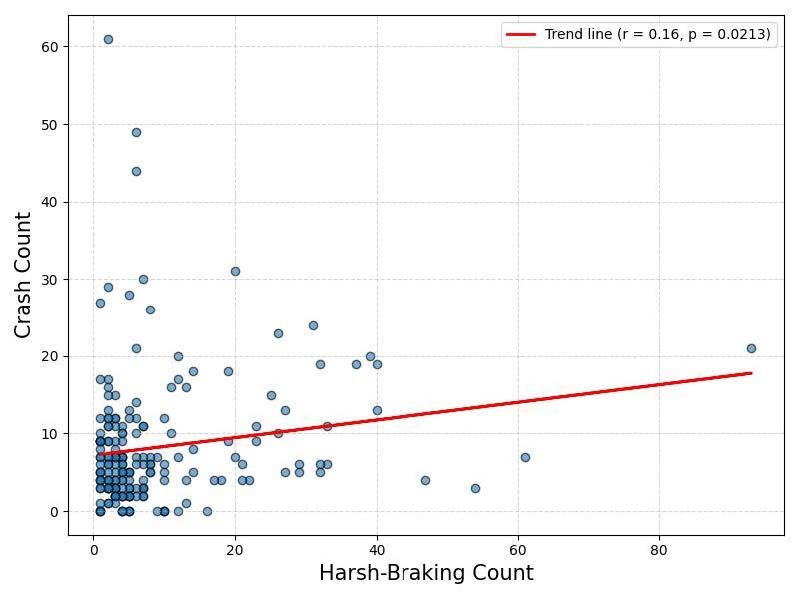
A. The major finding from this research is that harsh braking positively correlates with crash events. Segments with higher rates of harsh braking events also tended to experience higher rates of crash events. Our statistical analysis showed that each additional harsh braking event was associated with an increase in expected crash counts; for example, an increase of 10 harsh braking events corresponds to a roughly 10 percent higher expected crash frequency across New Jersey’s highway network.
Q. For roadway segments with elevated harsh braking rates, which safety countermeasures do you see as most promising? Would you prioritize engineering improvements, variable speed limits during adverse weather conditions, or other approaches?
A. For institutions and agencies, the major takeaway is that harsh braking data can be used proactively to identify high-risk locations and prioritize safety improvements. By monitoring harsh braking behavior in near real time, agencies can identify locations with a high potential for crashes before crashes actually occur. This allows agencies to implement safety countermeasures in advance, such as improved signage, variable speed limits, or other traffic control strategies, rather than reacting after crashes happen.
Q. You also received the ITSNJ 2025 Outstanding Graduate Student Award. Was this recognition for the same study or for other research? If the latter, could you briefly describe that work?
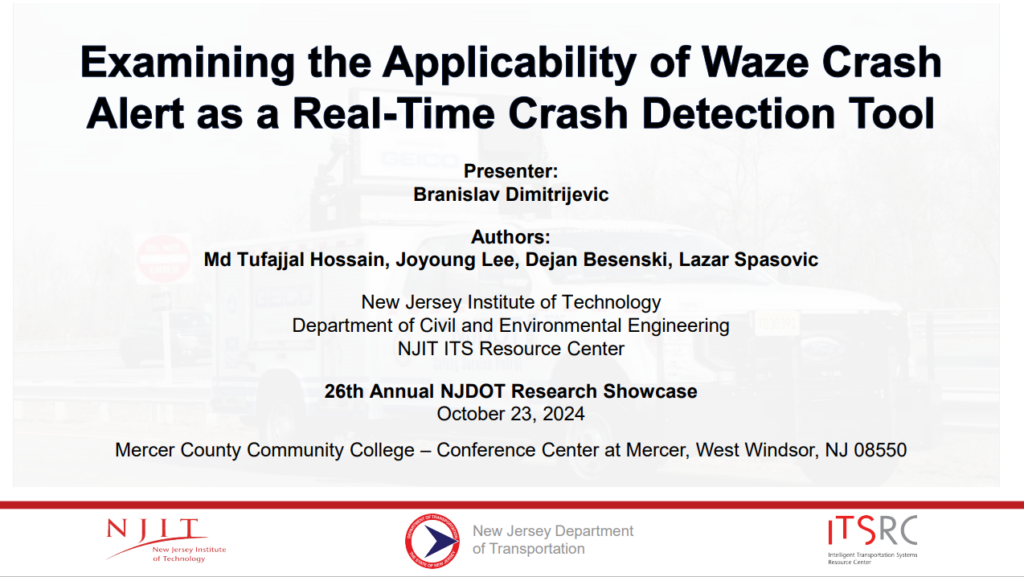
A. No, I received the ITSNJ 2025 Outstanding Graduate Student Award for different studies. One was an NJDOT-funded project that used a machine-learning–based approach and crowdsourced Waze data to develop an incident detection model. That work focused on improving Safety Service Patrol deployment at NJDOT.
In addition, I was involved in developing a crash severity prediction model using large language models (LLMs), which was recognized with the ITSNJ Best Poster Award. In a separate project, I contributed to a LiDAR-based pedestrian detection system aimed at improving pedestrian safety at intersections.
Q. Are there emerging areas of research or new technologies you are considering focusing on for your dissertation?
A. For my dissertation, I am planning to use advanced machine learning and connected vehicle data to improve the traditional four-step travel demand modeling, which requires costly and difficult-to-collect data such as Origin-Destination (OD) data. My research explores how connected-vehicle data can be used to replace or supplement traditional OD data and still produce reliable model outputs. The goal is to make four-step modeling more data-driven, practical, and scalable for transportation agencies.
Q. Looking ahead, do you see yourself leaning more toward academic research, applying your work in practice, or combining both paths?
A. Looking ahead, I see myself combining both academic research and practical application. I enjoy conducting rigorous research and developing new methods, but I strongly value that the research is applied to solve real transportation problems. My goal is to pursue an academic career while also continuing close collaboration with public agencies like NJDOT so that my research remains grounded in real-world needs. I believe this balance allows research to have greater impact and advance knowledge while directly improving transportation, safety and operations.