Interview with 2025 NJDOT Research Showcase Outstanding Student: Xiaoyu Zhang

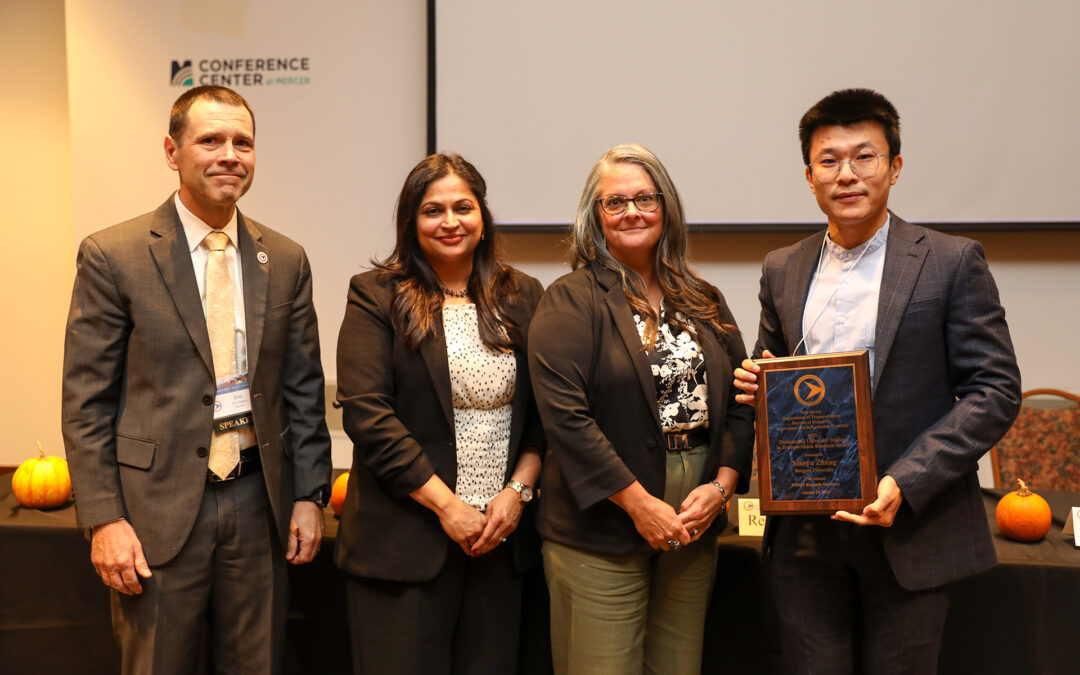
Rutgers PhD student Xiaoyu Zhang received the 2025 NJDOT Outstanding University Student in Transportation Research Award for his contributions to pavement engineering, traffic safety, and emerging sensing technologies. His work spans pothole detection, friction modeling, and variable speed limit systems, reflecting a blend of traditional engineering, computer vision, and machine learning. In this interview, he discusses his research journey, current projects, and how he hopes to translate innovative research into practical tools for transportation agencies.

Research Journey

Q. Congratulations on receiving the 2025 NJDOT Research Showcase Outstanding University Student in Transportation Research Award. Could you share a bit about your educational and research experience and how you became a PhD student researcher at Rutgers University?

A. First, I am truly honored to receive the NJDOT Outstanding Student Award. I know there are many excellent students in this field, so I really appreciate the committee’s consideration, and my advisor, Dr. Hao Wang, for his continuous support and guidance.

I received both my bachelor’s and master’s degrees in transportation engineering from Southeast University in China, where Dr. Wang also began his academic career. After my master’s program, I worked for two years with a highway design company, where I worked on project feasibility studies. This helped me gain real-world experience in transportation safety and policy, but the work itself was less innovative.

My path to Rutgers started when my master’s advisor informed me that Dr. Wang was recruiting PhD students and his research had a strong overlap with my previous work. During my master’s, I worked on 3D pavement surface scanning and data processing. I reached out to Dr. Wang and we arranged an online meeting, which made me more confident that Rutgers and this team were the right place for me. Soon after, I received the offer from Dr. Wang and decided to join. It was a big challenge to move to another country, but also a great opportunity to work with this innovative, highly productive research group.

Innovative Pothole Detection

Q. You’re working on the NJDOT-sponsored Innovative Pothole Repair Materials and Techniques project. What drew you to this research, and what are its key goals?

A. For the Innovative Pothole Repair Material and Techniques project, the first phase focused on asphalt pavement pothole repair, which was successfully completed by Dr. Wang and Dr. Xiao Chen. In phase two, our focus has shifted to concrete pavement pothole repair, and we are collaborating with Dr. Husam Najim and his team.

I’m particularly interested in the innovative techniques side of the project, especially for pothole detection. Our team decided to develop a low-cost 3D imaging system for pothole detection and assessment. The system can estimate a pothole’s volume and depth, which is helpful for determining severity and the amount of materials needed for repair. Currently, NJDOT conducts pavement assessments biannually, but potholes can develop and deteriorate very quickly. Our goal is to create a low-cost, efficient system for pothole detection and rapid repair, helping agencies identify and fix potholes earlier to prevent damage to the roadway and cars.

Our system uses three cameras to capture three images at different angles. Those images are processed in our algorithm in just a few seconds to generate a 3D model of the pothole to extract the volume, depth, and the area of the pothole. In our lab, we created a test pothole and scanned it with a high-resolution handheld 3D laser scanner, which costs around $30,000, and our low-cost, three-camera imaging system, which costs less than $1000. I found that there is less than a 1 percent relative error between the two systems. This demonstrates that our method provides sufficient accuracy for practical applications compared to commercial laser scanners.

3-Camera Imaging System. Image courtesy of Xiaoyu Zhang

Additionally, while the laser scanners are very accurate, they are also expensive, time-consuming, and hard to mount on moving vehicles. In contrast, our system uses compact and affordable GoPro cameras, which are easy to mount and resistant to vibrations. This makes our system much more suitable for our main goal: providing a rapid, low-cost estimation of pothole geometry.

Q. What would be the next steps? Is it just implementation at this point or is it further refining of the process?

A. Our next goal is to adapt this low-cost system for real-world use. There are several challenges we need to address before deployment, such as handling the continuous video data, managing vehicle vibration and speed, optimizing the camera mounting height and angle, and improving the real-time processing algorithm. We aim to make the system more robust and user-friendly for transportation agencies. Ultimately, our goal is to have this system easily mounted on a regular car. After a simple calibration, it could automatically detect potholes during daily driving and provide real-time information for quick pothole repair decisions.

Pavement Resource Program

Q. You also contribute to the NJDOT Pavement Resource Program. What aspects of the project are you involved in, and what potential benefits could this work provide to NJDOT and the broader transportation field?

Polishing Machine. Image courtesy of Xiaoyu Zhang

A. I have been working on the Pavement Resource Program for about two years. This is a long-term research program conducted by Rutgers Pavement Lab in collaboration with NJDOT, and the goal is to understand the long-term performance of pavement surface friction and develop strategies for improving roadway safety and durability. My work involves two main components: lab testing and field data collection.

In the lab, we prepared numerous asphalt mixtures with different aggregates and material types. Then, we used an accelerated polishing machine to simulate tire wear over time for up to 50,000 cycles. Afterward, we measured the surface texture and friction to analyze how texture deterioration affects skid resistance. In the field, we conducted a survey using a high-resolution profiler to test the pavement surface texture and the friction. By comparing the lab and the field data, we aim to establish a correlation between the pavement surface texture and friction performance.

I think this project has great potential benefit for NJDOT and the broader transportation community. From the material perspective, we help identify mixtures and aggregates that maintain high friction over time, improving roadway safety and reducing maintenance costs. From the data and monitoring side, understanding how texture parameters relate to friction allows us to develop a predictive model for further friction prediction.

Q. What are the next steps for the research in the Pavement Resource Program?

A. Our next step is to continue the long-term monitoring and model development. We plan to strengthen the link between the lab and field data, and expand the dataset across more field sites, materials, and gradations. With the new data, we can develop a prediction model to estimate the pavement friction from texture parameters.

Variable Speed Limits

Q. You were also recognized with the ITSNJ 2025 Outstanding Graduate Student Award for your study of variable speed limits in adverse weather conditions. What did that study involve, and what were your key findings?

Variable Speed Limit Map. Image courtesy of Xiaoyu Zhang

A. This project’s focus on traffic safety and adverse weather conditions combined two key areas of my research: pavement surface friction and vehicle dynamic performance. We used real-time monitoring data from road weather information systems, which estimate the pavement surface friction during adverse weather such as rain and snow. Under those conditions, surface friction drops significantly, increasing the risk of skidding, especially while turning at high speed. Our goal is to develop a variable speed limit system that adapts to the real-time friction levels. To establish this, we conducted vehicle dynamic simulations, modeling vehicle cornering behavior at different speeds. This simulation allows us to determine the minimum friction demand required for safe driving under each scenario. When our sensor measures that the friction drops, we calculate an appropriate variable speed limit for that curve.

Interdisciplinary Approach

Q. Your work combines traditional engineering, computer vision, and machine learning. How does this interdisciplinary approach influence how you address transportation infrastructure challenges?

A. My goal is to bridge the gap in adapting advanced technology to solve practical, real-world engineering problems. In transportation research, machine learning is becoming increasingly popular; however, many models are black boxes, making it hard for engineers to apply the results in practice.

To address this, I focus on interpretable machine learning models, incorporating domain knowledge, to help us understand why certain patterns occur. Similarly, when using computer vision, technology like 3D reconstructions and object detection are very important, and I aim to customize them for specific engineering needs such as pothole detection, surface texture, and condition assessment. Overall, this approach allows me to bring the strengths of data science and computer vision into the context of civil and transportation engineering, creating solutions that are both innovative and grounded in engineering reality.

Future Research

Q. Are there emerging areas of research or technology you are especially interested in exploring for your dissertation?

A. For my dissertation, I aim to develop a comprehensive framework for traffic safety evaluation that integrates multiple key factors, including surface texture friction, adverse weather conditions, and vehicle dynamic performance. By combining those aspects, I hope to create a model that can more accurately assess vehicle safety performance in real-world driving conditions and provide data-driven recommendations for transportation agencies. I am also very interested in extending this research to airfield safety, exploring how runway conditions influence airplane safety. The same principles of friction and parallel interaction applies to airplane landing performance.

Xiaoyu Zhang presenting at TRB. Image courtesy of Xiaoyu Zhang

Q. Looking ahead, do you see yourself focusing more on academic research, putting your findings into practice, or a combination of the two?

A. I hope to combine both. Through research, we can discover new ideas, new methods, and technologies to expand our understanding of complex engineering problems. But, I also feel very rewarded by applying those research findings into practice to see how our ideas can directly improve safety, efficiency, and sustainability. My ultimate goal is to bridge the gap between theory and applications, turning innovative research into practical engineering solutions that benefit the public and transportation agencies.

References

Wang, Y., Yu, B., Zhang, X., & Liang, J. (2022). Automatic extraction and evaluation of pavement three-dimensional surface texture using laser scanning technology. Automation in construction141, 104410.

Zhang, X., Wang, H., & Bennert, T. (2025). Tire Polishing Effects on Rubber-Texture Contact and Friction Characteristics of Different Asphalt Mixtures. Wear, 206328.

Zhang, X. & Wang, H. (2025). Determination of Variable Speed Limit on Horizontal Curves at Adverse Weather Conditions. The TRB 105th Annual Meeting. Washington, DC.

Zhang, X. & Wang, H. (2025). Long-Term Prediction of Asphalt Pavement Surface Friction Using Interpretable Machine Learning Models. The TRB 105th Annual Meeting. Washington, DC.

Research Spotlight: Innovative Pothole Repair Materials and Techniques

A recently completed NJDOT research study, Innovative Pothole Repair Materials and Techniques, tested several new techniques and materials that could improve the cost-effectiveness of pothole repairs in New Jersey. Phase I of the research project, led by Professors Hao Wang and Husam Najm of Rutgers University, evaluated new methods for both asphalt and concrete structures. Pothole repair is one of the primary maintenance activities for highway agencies, generating significant costs and resource commitments. Cost-effective pothole repair methods can reduce or eliminate the possibility of re-patching and save future repair costs.

Asphalt Pothole Repair

Asphalt pavement is continuously subjected to vehicular and environmental loading throughout its lifecycle, leading to the inevitable occurrence of distresses such as cracking, rutting, raveling, potholes and so on. Among these distresses, potholes are critical as they can disrupt traffic, impose risks to safety, and cause costly vehicular damage for vehicle operators.

Field repair of pothole using induction heating.

Pothole repair is a primary maintenance activity for highway agencies. Typically, cold mix asphalt is used for emergency repair and hot-mix asphalt (HMA) for traditional repairs. Usual pothole repair methods include throw and go (roll), edge seal, semi-permanent, spray injection, and full depth repair. Among them, throw and go (roll) method using HMA has been adopted by most transportation agencies for surface patching. However, this common practice largely relies on the usage of HMA. Although the quality of the asphalt patch can be ensured, it presents environmental concerns due to the energy consumption and environmental footprint involved in producing new HMA. To mitigate the impact on the environment, reduce cost and conserve energy, recycled asphalt pavement (RAP) has been widely used as a highly desirable material. The addition of recycled asphalt pavement (RAP) in asphalt mixtures can bring numerous economic and environmental advantages.

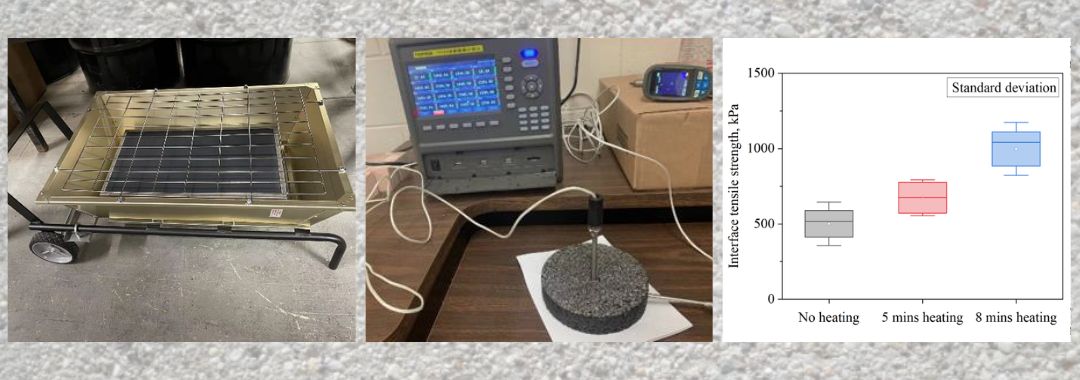
Infrared heating test was used in asphalt repair method.

This study sought to investigate an innovative approach to pothole repair using HMA with RAP and preheating. The study investigated two aspects: First, the performance of HMA with different RAP contents were evaluated through laboratory tests to select the most appropriate content. Second, the in-site strength of pothole repair was evaluated with field cores to quantify the benefits of repair quality due to recycled material and preheating.

Both microwave heating and infrared heating were tested, with varying results. Microwave heating was able to warm both the surface and internal materials of the pavement, however, its efficiency was low and the rate of temperature increase was insufficient. Conversely, the infrared heating method proved adept at rapidly heating the top edges and bottom surface of the pothole to high temperatures and was used successfully in pothole repair.

Further tests were carried out adding RAP to HMA patching materials. The results showed that there was greater abrasion loss, reduced IDT (indirect tensile strength), and interface shear strength of patching material had less resistance to moisture as RAP content increased. Nonetheless, with the application of preheating, the overall performance of HMA containing 30 percent RAP was satisfactory, proving that it is feasible to use RAP material for pothole repair.

Concrete Pothole Repair

Photos showing condition ratings for concrete repairs.

Similar to asphalt pavement, concrete structures are prone to deterioration due to vehicles and weathering. Cracks can develop which lead to further deterioration due to chloride infiltration. Thus, a good repair is necessary for maintaining concrete structures. An ideal repair material should be easy to work with under different weather conditions, be fast setting, and possess good durability. Rapid-setting cementitious patch repair materials are popular for repairing small concrete damage and providing a functional repair within few hours.

Based on extensive literature research and several NJDOT practices, three formulations were chosen as the best performing candidates. Workability, strength, and restrained shrinkage cracking of the formulations were investigated. The restraint shrinkage test protocol simulated upper and lower limits of restraint that a repair material undergoes in real applications. The repairs were also cast and placed in external environmental conditions to expose them to natural weathering actions. The cracking behavior was evaluated including cracking spacing and maximum crack width

The investigation led to the identification of three formulations that did not crack for a period of 10 months in field exposure to NJ climate conditions. Typically, rapid set formulations do not shrink after 6 months. The formulations that did crack revealed that an addition of 1 percent of PVA fibers could significantly reduce the maximum crack width. The maximum crack widths observed in all the formulations were an order of magnitude less than the maximum allowable crack width specified by NJDOT (1/32″).

Contemplated Legislation

The research projects were completed at a time when pothole repairs have attracted critical attention from motorists and legislators within the state. In the current legislative session (2024-2025), the New Jersey State Senate voted unanimously to advance a bill that is intended to address concerns about pothole damage to roads and bridges in the Garden State. 

The NJ Senate bill, S862, would require the state DOT to include information about pothole repair projects and their cost in the annual report. The additional information would include reporting on the number of repair projects going on around the state and their cost. The bill includes a separate provision that would require a lifecycle cost analysis to be conducted.  The information would be required to be made available to the public on the NJDOT’s website.  An identical bill, A2596, was introduced in the NJ Assembly during the legislative session.

AASHTO Recognition 

The research project is not only primed to inform the serious legislative issues being raised in Trenton but was recently recognized by the American Association of State Highway Officials (AASHTO) for its contribution to innovation. Every year, the High Value Research Task Force of AASHTO Research Advisory Committee (RAC) holds a national competition to find “high value” research projects throughout the country. In 2024, the Innovative Pothole Repair Materials and Techniques research project was recognized in the Maintenance, Management, and Prevention supplemental category, as described here.


RESOURCES

Wang, Hao, and Xiao Chen. “Innovative Pothole Repair Materials and Techniques Volume I: Asphalt Pavement.” (2024). Final Report. Retrieved here.

Wang, Hao, and Xiao Chen. Innovative Pothole Repair Materials and Techniques Volume I: Asphalt Pavement. (2024). Technical Brief. Retrieved here.

Najm, Husam, Bala Balaguru, Hao Wang, Hardik Yagnik, and Alissa Persad. “Innovative Pothole Repair Materials and Techniques Volume II: Concrete Structures.” (2024). Final Report. Retrieved here.

Najm, Husam, Bala Balaguru, Hao Wang, Hardik Yagnik, and Alissa Persad. “Innovative Pothole Repair Materials and Techniques Volume II: Concrete Structures.” (2024). Technical Brief. Retrieved here.

Asphalt Pavement Pothole Repair with Recycled Material and Preheating. Presentation at NJDOT Research Showcase by Xiao Chen and Hao Wang. Retrieved here (Presentation) and here (Recording).


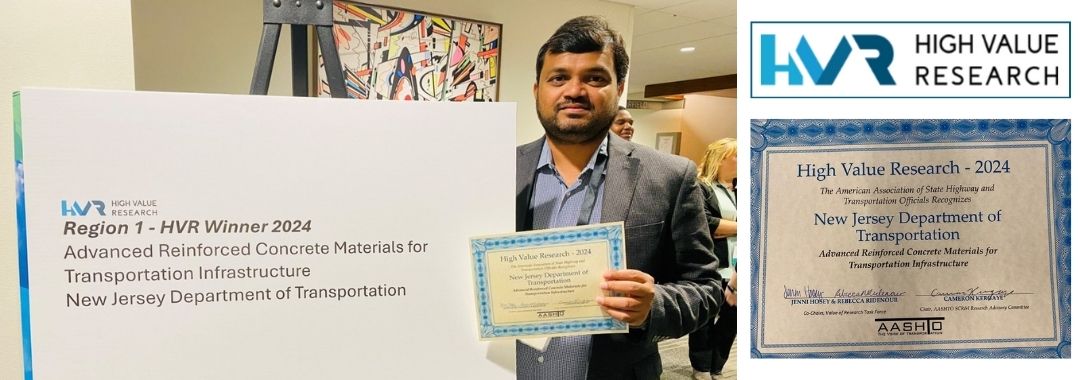
Dr. Giri Venkiteela, Research Scientist, BRIIT, accepted two awards on behalf of the New Jersey Department of Transportation.

NJDOT Research Projects Receive High Value Research and Supplemental Awards by the AASHTO Research Advisory Committee

The Bureau of Research, Innovation and Information Transfer (BRIIT) is active in many national transportation efforts, including the American Association of State Highway Transportation Officials (AASHTO). Dr. Giri Venkiteela, Research Scientist, BRIIT, is the Vice Chair of Region 1 of AASHTO’s Research Advisory Committee (RAC) that serves the Special Committee on Research & Innovation (R&I).

In late July 2024, he attended the RAC’s National Meeting in Columbus, Ohio and accepted two awards on behalf of the New Jersey Department of Transportation.


Every year, the High Value Research Task Force of AASHTO RAC holds a national competition to find four “high value” research projects from each of the four AASHTO regions in the country. In 2024, two research projects sponsored and managed by the New Jersey Department of Transportation were recognized nationally with awards.

Several experimental and numerical research activities were carried out to assess the mechanical properties and long-term durability of Advanced Reinforced Concrete materials

The first project, Advanced Reinforced Concrete Materials for Transportation Infrastructure, was recognized as one of top 16 projects in the country and was managed by Dr. Venkiteela. The Principal Investigator for the study was Dr. Matthew Bandelt from the New Jersey Institute of Technology (NJIT) and championed by NJDOT’s Bureau of Materials.

Transportation infrastructure systems must resist conditioning from the natural environment and physical demands from service loading to meet the needs of users across the state. Reinforced concrete, which is widely used in bridge decks, pavements, super- and substructures, and other systems, deteriorates under environmental conditioning due to electro-chemical processes that cause expansive mechanics stresses at various length scales (e.g., reinforcement corrosion, freeze-thaw, etc.), leading to costly and timely durability and maintenance challenges.

The project report, which provides a background on the state-of-the-art of advanced reinforced concrete materials that are being investigated to improve reinforced concrete transportation infrastructure. A series of experimental and numerical research activities were then carried out to assess the mechanical properties and long-term durability of these systems. Results show benefits across a range of metrics and have the potential to substantially improve the in-service behavior of reinforced concrete transportation infrastructure.

Methods to preheat an excavated pothole prior to repair were described to improve the interface bonding between existing pavements and hot filling material.

The second project, Innovative Pothole Repair Materials and Techniques, was recognized in the Maintenance, Management, and Prevention supplemental categories and was also managed by Dr. Venkiteela. Separate research reports were prepared for asphalt (Volume I) and concrete structures (Volume II). The Principal Investigator for the study was Dr. Hao Wang from Rutgers-Center for Advanced Infrastructure and Transportation.

Pothole repair is one of the most important and frequent maintenance activities for highway agencies. Significant amounts of costs and resources are spent in pothole repair for material, labor, equipment, and traffic control. Cost-effective pothole repair methods can reduce or eliminate the possibility of re-patching and save future repair costs. The good condition of pothole repair with less cracking will also prevent reflective cracking when asphalt overlay is placed. Preheating the excavated pothole prior to repair has been found to improve the interface bonding between existing pavements and hot filling material, which can help enhance the overall performance of asphalt patches.

The long lifespan of a durable patch will reduce travel delay due to work zone and safety risk of highway users and workers. They will better preserve the condition of highway infrastructure and provide better service to the traveling public. The feasible usage of recycled materials can reduce the production of new material, which can contribute towards a more sustainable approach of roadway repair with economic and environmental benefits.

Additional information about the research teams for each research project and links to Final Reports, Technical Briefs, and select presentations given at the NJDOT Research Showcase or at Lunchtime Tech Talk can be found in the resources section below.


Resources

Bandelt, Matthew J., Matthew P. Adams, Hao Wang, Husam Najm, Andrew Bechtel, Seyed Masoud Shirkorshidi, and Jin Fan. Advanced Reinforced Concrete Materials for Transportation Infrastructure. No. FHWA NJ-2023-003. New Jersey. Department of Transportation. Bureau of Research, 2023. Final Report. Retrieved here.

Bandelt, Matthew J., Matthew P. Adams, Hao Wang, Husam Najm, Andrew Bechtel, Seyed Masoud Shirkorshidi, and Jin Fan. Advanced Reinforced Concrete Materials for Transportation Infrastructure. No. FHWA NJ-2023-003. New Jersey. Department of Transportation. Bureau of Research, 2023. Technical Brief. Retrieved here.

Lunchtime Tech Talk! Webinar: Advanced Reinforced Concrete Materials for Transportation Infrastructure. Webinar. Presentations by Matthew Bandelt and Matthew Adams. Retrieved here.

Wang, Hao, and Xiao Chen. “Innovative Pothole Repair Materials and Techniques Volume I: Asphalt Pavement.” (2024). Final Report. Retrieved here.

Wang, Hao, and Xiao Chen. Innovative Pothole Repair Materials and Techniques Volume I: Asphalt Pavement. (2024). Technical Brief. Retrieved here.

Najm, Husam, Bala Balaguru, Hao Wang, Hardik Yagnik, and Alissa Persad. “Innovative Pothole Repair Materials and Techniques Volume II: Concrete Structures.” (2024). Final Report. Retrieved here.

Najm, Husam, Bala Balaguru, Hao Wang, Hardik Yagnik, and Alissa Persad. “Innovative Pothole Repair Materials and Techniques Volume II: Concrete Structures.” (2024). Technical Brief. Retrieved here.

Asphalt Pavement Pothole Repair with Recycled Material and Preheating. Presentation at NJDOT Research Showcase by Xiao Chen and Hao Wang, Retrieved here (Presentation) and here (Recording).